
Basement Mold Remediation in Philadelphia, PA
24/7 Response by Certified Technicians across Philadelphia. Call us now at (267) 641-0090 and we will be there.
- 60 min response
- IICRC Certified #70209237
- We Handle Insurance
Request a Free Inspection
Local experts • Fast response • No hidden fees
If you have found mold in your basement, you need to act today. Mold spreads within 24 to 48 hours of moisture exposure, migrates through walls, and degrades the air quality on every floor of your home.
Jefferson Water Damage & Restoration Philadelphia provides same-day basement mold remediation in Philadelphia for homeowners dealing with active growth, water damage aftermath, or a musty smell they cannot explain.
Our IICRC-certified technicians respond around the clock, assess the full scope of contamination, and remediate the problem from start to finish. Call us now at +1 267 641-0090.
Philadelphia Basement Mold Is a Serious Problem, And It Moves Fast
Philadelphia receives approximately 60 inches of precipitation annually. Average summer relative humidity hovers around 65 percent. That combination, layered on top of a housing stock where many homes are well over 100 years old, creates one of the most mold-prone basement environments in the Northeast. In an indoor environment, mold can begin growing in as little as 24 hours and spread to other parts of the home within 48 hours.
Philadelphia basements are also affected by the stack effect. Warm air rises through a home continuously, carrying mold spores from the basement upward through living spaces. A mold problem in your foundation level quickly becomes an air quality problem in your kitchen, bedroom, and everywhere in between.
Most mold problems in Philadelphia basements trace back to a water event. Basement flooding is one of the most common triggers, and standing water that is not fully extracted creates the moisture conditions mold needs to take hold. The faster you address it, the lower the cost and the lower the health risk.
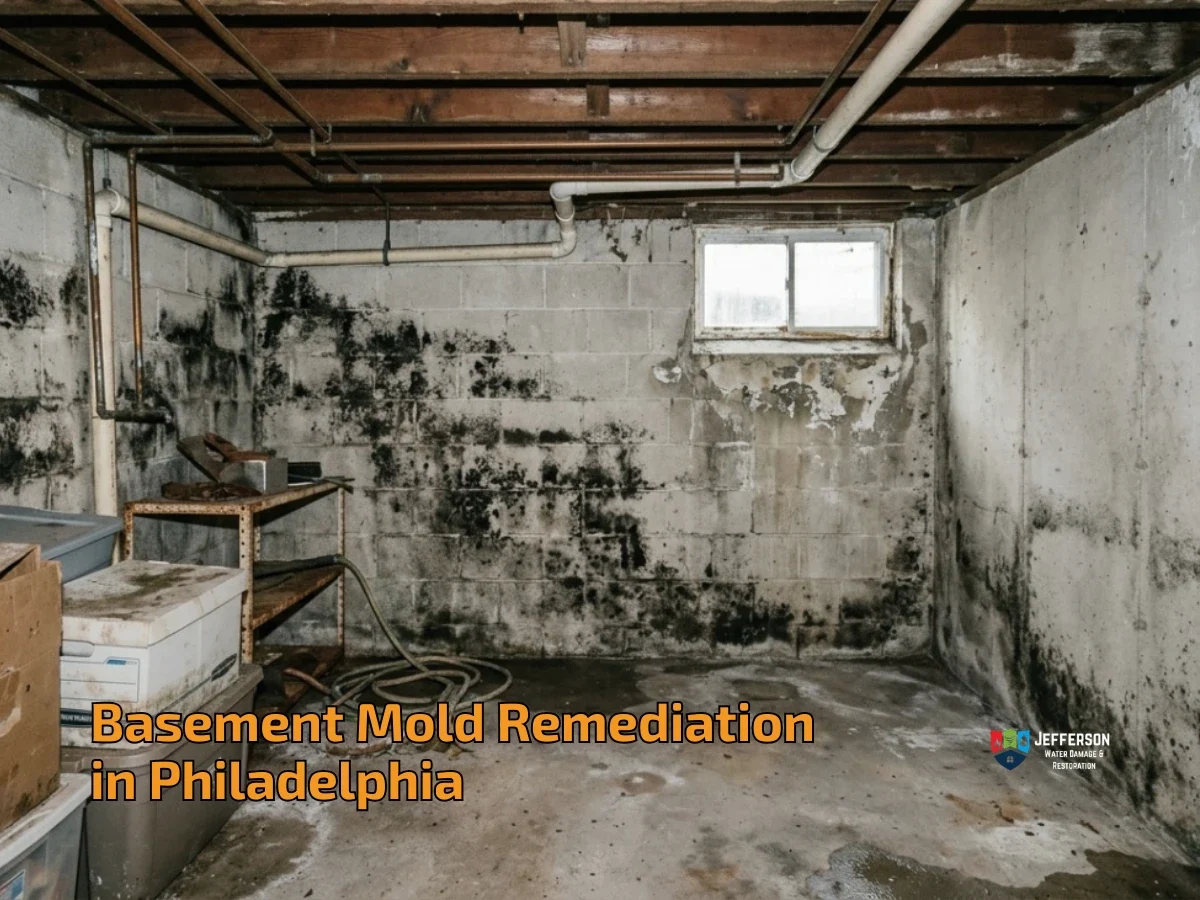
Why Philadelphia Basements Are So Vulnerable to Mold
Most cities have mold problems. Philadelphia has particular ones. Understanding why helps you recognize warning signs early and take the right next step. Not sure if your home or business has mold? We offer mold inspection and testing services in Philadelphia.
Aging Row Home Construction
Philadelphia is one of America’s oldest cities, and its row homes reflect that history. Many were built before modern ventilation codes existed. Brick and plaster basement walls trap moisture instead of repelling it. Original dirt floors have been converted into finished living spaces, often without proper vapor barriers or drainage systems. The result is a basement that holds humidity in ways newer construction simply does not.
Clay Soil and Hydrostatic Pressure
Philadelphia’s soil is clay-heavy. When saturated, clay expands and pushes against foundation walls with significant force. That hydrostatic pressure drives moisture through foundation cracks and block walls directly into your basement, even without a visible leak.
Condensation in Below-Grade Spaces
For every 1 degree Fahrenheit the temperature drops, relative humidity rises by approximately 2.2 percent. When warm, humid summer air enters a cooler basement, humidity spikes fast. That condensation alone can sustain mold colonies without any plumbing failure or flooding involved.
Shared Walls in Rowhouses
In a Philadelphia rowhouse, your basement shares walls with your neighbors on both sides. Mold in one unit can migrate through shared masonry into the adjacent property. Remediation in these structures sometimes requires awareness of what is happening on the other side of that wall.
Water Damage History
Hidden plumbing leaks are a leading cause of basement mold in Philadelphia’s aging infrastructure. Burst pipes during winter freezes, slow drips behind finished walls, and failed sump pumps all introduce moisture that feeds mold growth long before it becomes visible. If you have experienced any water event in the past year and did not have the space professionally dried, mold is a real possibility.
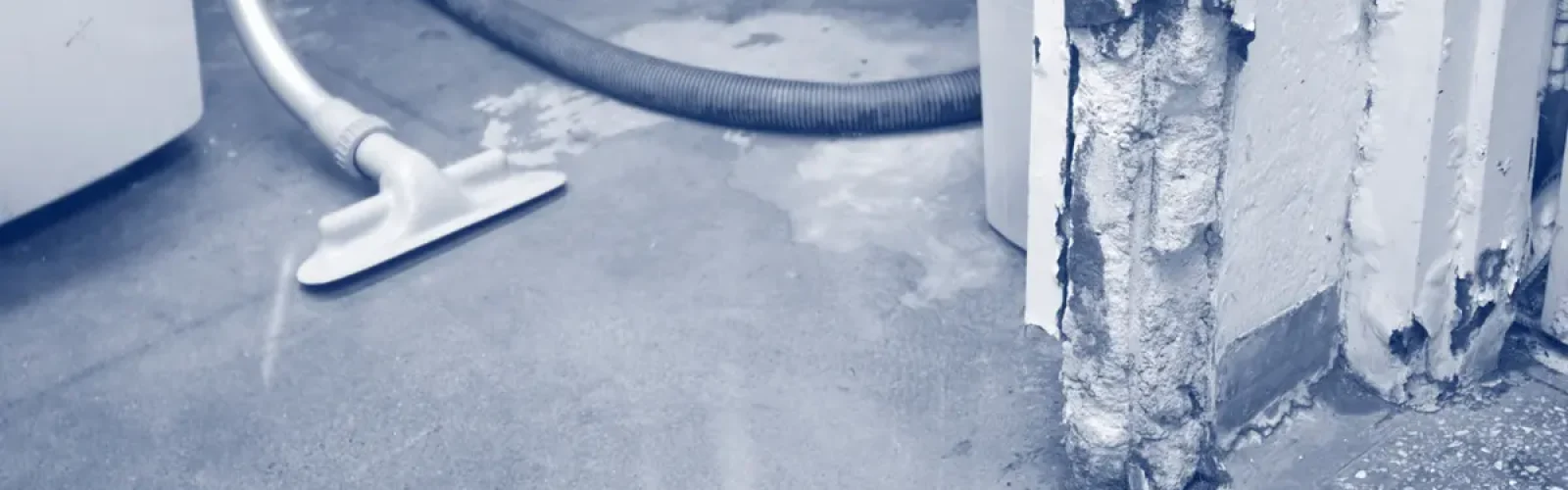
Signs You Have Basement Mold, And When to Call a Professional
Mold is not always visible at first. Philadelphia homeowners should watch for these warning signs in their basements and throughout the rest of the home.
Visible discoloration on walls, floor joists, drywall, or stored belongings. Colors range from black and green to grey and white.
A persistent musty or earthy smell in the basement or in rooms directly above it.
Respiratory symptoms such as coughing, congestion, or wheezing that improve when you leave the house. This pattern is a meaningful indicator of indoor mold exposure.
Peeling paint, bubbling drywall, or white mineral deposits on basement walls.
Soft floor joists, warped wood paneling, or spongy spots in the subfloor above.
Recurring condensation on pipes, concrete walls, or HVAC components.
The EPA recommends professional remediation for any mold covering more than 10 square feet. In Philadelphia basements, the visible surface growth rarely reflects the full extent of contamination. Mold typically spreads inside wall cavities, beneath flooring, and through wood framing long before you see it. DIY cleaning without proper containment spreads spores to clean areas and does not address the root cause.
If your concern involves dark, slimy growth consistent with black mold, that situation calls for additional precautions and a specific remediation protocol.
Jefferson's Basement Mold Remediation Process in Philadelphia
Every job follows the IICRC S520 standard for mold remediation. Here is what that looks like in practice.
Step 1: Same-Day Assessment and Inspection
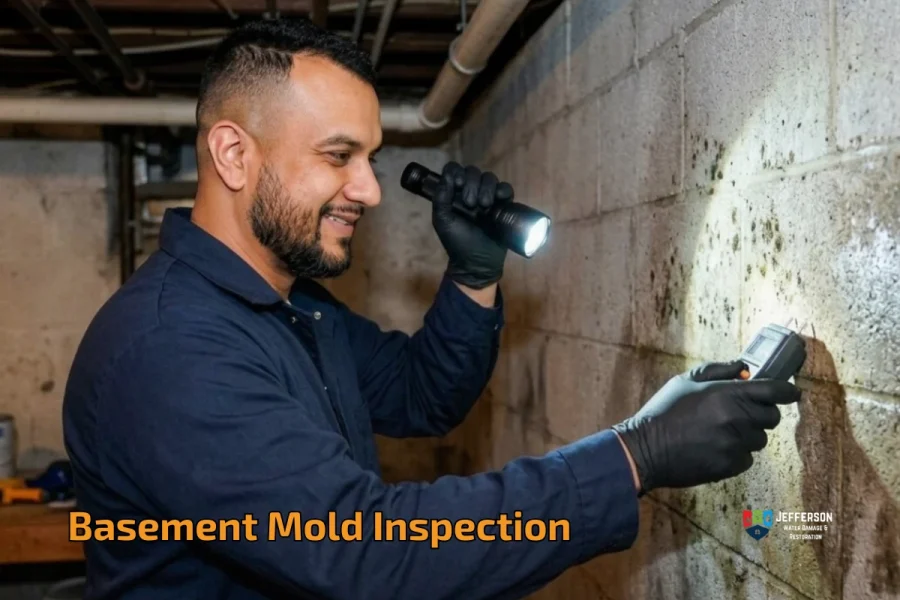
A certified technician arrives the same day. Using thermal imaging cameras, moisture meters, and visual inspection, the crew maps the full scope of contamination, including growth behind finished walls and under flooring that you cannot see. This assessment drives the remediation plan and provides documentation for your insurance carrier if needed.
Step 2: Containment
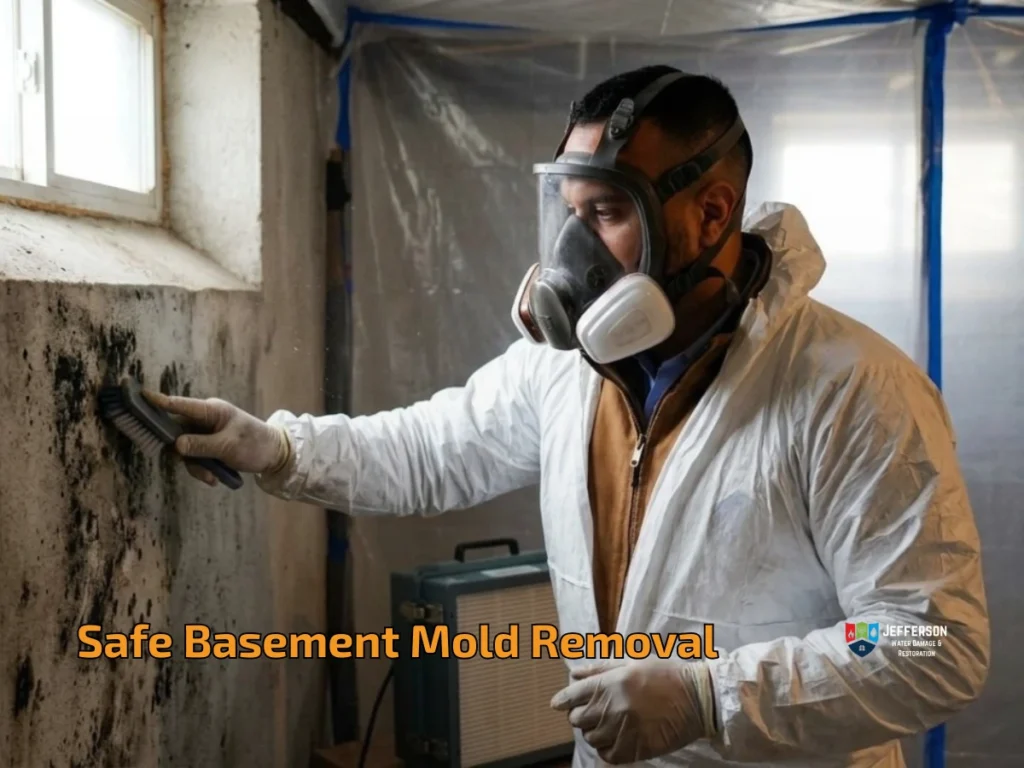
The affected area is sealed off with heavy-gauge plastic sheeting and negative air pressure systems. This keeps mold spores from migrating to clean areas of your home during the removal process. HVAC systems are shut off to prevent airborne spread through ductwork.
Step 3: HEPA Air Filtration
Commercial HEPA air scrubbers run throughout the remediation. They capture airborne spores continuously, protecting your family’s indoor air quality from the moment work begins.
Step 4: Mold Removal and Material Disposal
Porous materials that have absorbed mold, including drywall, insulation, carpet, and compromised wood framing, are removed and disposed of per Philadelphia environmental protocols. Non-porous structural surfaces are cleaned, treated, and prepared for the next step.
Step 5: Antifungal and Antimicrobial Treatment
All affected surfaces receive EPA-registered antifungal and antimicrobial treatments. These eliminate residual mold colonies and inhibit regrowth on treated surfaces.
Step 6: Drying and Humidity Control
Industrial dehumidifiers and air movers bring the basement below the 50 percent relative humidity threshold where mold cannot survive. If water extraction is still needed at this stage, we complete it before drying equipment is placed.
Step 7: Documentation and Clearance
efferson provides a written scope of work, moisture readings, photos, and a full remediation record upon completion. This documentation supports homeowners insurance claims and gives you a clear record of the work performed.
How Much Does Basement Mold Remediation Cost in Philadelphia?
Mold remediation in Philadelphia typically costs between $1,300 and $3,700, with most basement-specific projects running $500 to $3,000 for surface-level contamination. Costs rise when mold has grown inside finished walls, wood framing, or beneath flooring. Most mold removal professionals charge $10 to $25 per square foot, depending on the scope and materials involved.
Philadelphia’s older housing stock, common in neighborhoods like Fishtown, South Philly, West Philly, and Manayunk, frequently includes original brick, plaster walls, and aged wood framing. Jefferson’s team has extensive experience working in these older homes, using techniques that protect original materials while completely removing the mold at its source.
The location of growth matters significantly. Mold behind wood paneling or inside wall cavities requires opening and replacing those materials, which adds to both labor and material costs. The size of the affected area, the type of materials involved, the mold species present, and whether the underlying moisture source needs repair all shape the final scope.
Addressing the moisture cause whether that is a burst pipe, a foundation crack, or a hidden plumbing leak, is essential to prevent recurrence and is typically quoted as part of the same project.
Some homeowners insurance policies cover mold remediation when it results from a covered peril such as a sudden pipe failure. Mold caused by long-term moisture buildup or gradual seepage is typically excluded. Jefferson provides the written documentation insurance carriers require when evaluating these claims. Review your policy directly and ask us for a written assessment before filing.
Jefferson provides a transparent written estimate before any work begins — no surprise charges, no scope changes without your approval.
Preventing Basement Mold from Coming Back
Remediation removes the mold that exists today. Keeping it from returning means eliminating the conditions that created it.
Maintain indoor humidity between 30 and 50 percent year-round. A dedicated basement dehumidifier running through Philadelphia’s humid summers makes a measurable difference.
Check your sump pump before the rainy season and replace it if it shows signs of wear. A failing sump pump is one of the most common causes of recurring basement flooding and secondary mold growth in Philadelphia homes.
Install a vapor barrier on basement walls and beneath the slab if one is not already present. Many older Philadelphia row homes were built without any moisture barrier between the foundation and the living space. Addressing that gap dramatically reduces the groundwater intrusion that feeds mold.
Never store cardboard, paper, or fabric on the basement floor. Use sealed plastic bins instead. These organic materials are prime mold food sources.
If mold returns after remediation, an unresolved moisture source is almost always the reason.
Professional leak detection is the recommended starting point when the cause is not obvious. Finding and fixing that source before the next remediation saves both money and time.
How Jefferson Restoration Works?
01
Immediate Response
24/7 emergency dispatch
02
Free Assessment
Transparent inspection and estimate
03
Insurance Coordination
We work directly with your provider
04
Restoration & Repair
From damage control to complete rebuild
Serving Philadelphia Neighborhoods, Jefferson Responds Fast
Jefferson Water Damage & Restoration operates from 443 W Girard Ave in the Northern Liberties corridor and serves all of Philadelphia 24 hours a day. Basements account for a substantial share of mold remediation calls across the city, and our crews are familiar with the housing types, drainage patterns, and infrastructure challenges in every part of Philadelphia.
We serve Northern Liberties (19123), Fishtown (19125), Kensington (19134), Port Richmond (19134), Brewerytown (19121), Fairmount (19130), Spring Garden (19130), Callowhill (19123), Strawberry Mansion (19121), Frankford (19124), Bridesburg (19137), Tacony (19135), Holmesburg (19136), Mayfair (19135), Bustleton (19115), Fox Chase (19111), Rhawnhurst (19111), and all of Northeast Philadelphia (19114, 19116, 19152, 19154).
We also respond throughout Olney (19120), Germantown (19144), Mt. Airy (19119), Chestnut Hill (19118), Roxborough (19128), Manayunk (19127), East Falls (19129), Hunting Park (19140).
West Philadelphia (19104, 19139, 19143), University City (19104), Grays Ferry (19146), Point Breeze (19146), Passyunk Square (19148)
South Philadelphia (19147, 19148, 19145), Rittenhouse Square (19103)
Center City (19102, 19103, 19107), Old City (19106), and Society Hill (19106).
Outside the city, we serve Cheltenham, Elkins Park, Jenkintown, Abington, Norristown, Conshohocken, King of Prussia, Upper Darby, Drexel Hill, Springfield, Media, and Chester.
Frequently Asked Questions About Basement Mold Remediation in Philadelphia
How fast can mold grow in a Philadelphia basement?
Mold can begin growing in as little as 24 hours after a moisture event, and it can spread to other areas of the home within 48 hours. Philadelphia’s average relative humidity of 65 percent keeps basement environments consistently above the 50 percent threshold where mold thrives. If your basement has experienced flooding, a pipe leak, or visible condensation, contact a remediation professional now rather than waiting to see if mold appears.
Can I clean basement mold myself, or do I need a professional?
Small patches on non-porous surfaces under 10 square feet may be manageable with proper equipment. In a Philadelphia basement, though, visible mold almost always reflects a larger problem inside walls, framing, and flooring that cannot be cleaned without professional containment and removal. Without proper containment, DIY cleaning spreads spores to clean areas and leaves the underlying colony intact.
Will homeowners insurance cover basement mold remediation in Philadelphia?
Coverage depends on the cause. Mold resulting from a sudden covered peril, like a burst pipe, is often covered. Mold from gradual moisture buildup or long-term seepage is typically excluded. Jefferson documents the damage source, scope, and remediation plan in the format insurance carriers require. Always review your specific policy and ask Jefferson for a written assessment before filing a claim.
What types of mold are most common in Philadelphia basements?
Cladosporium, Penicillium, and Aspergillus are the most frequently encountered species in Philadelphia basement environments. Stachybotrys chartarum, commonly called black mold, grows more slowly but is associated with greater
Stop
Mold Growth in Your Basement
Get a Free Professional Inspection
Local experts • Fast response • No hidden fees