Black Mold Remediation in Philadelphia, PA
Do you suspect there is black mold in your house? Call us now at (267) 641-0090 for a free inspection. Available 24/7.
- 60 min response
- IICRC Certified #70209237
- We Handle Insurance
Request a Free Inspection
Local experts • Fast response • No hidden fees
Black mold in a Philadelphia home is not something you wait on. It spreads fast, it affects your health, and it gets more expensive to fix the longer it sits.
Jefferson Water Damage & Restoration Philadelphia provides black mold remediation in Philadelphia PA for homeowners and businesses across the city, with same-day response, IICRC-certified technicians, and full documentation for insurance claims.
Call us now at (267) 641-0090 and we will be there.
Why Philadelphia Homes Are Especially Vulnerable to Black Mold
Philadelphia has one of the oldest housing stocks in the country. Rowhouses in Kensington, Point Breeze, and Germantown were built long before modern ventilation standards existed. Many feature plaster walls, brick basements, and no vapor barriers, materials and construction methods that trap moisture and give mold exactly what it needs to take hold.
The city’s location between the Delaware and Schuylkill Rivers keeps ambient humidity elevated, particularly in the summer months when outdoor relative humidity routinely exceeds 60 percent. When that humid air enters a poorly ventilated rowhouse basement or crawl space, conditions for mold growth are near-ideal.
Trinity homes in Queen Village, flat-roof rowhouses in South Philadelphia, and pre-war brownstones in Brewerytown share the same vulnerability: moisture gets in, and it has nowhere to go.
Shared party walls create another problem unique to Philadelphia. A moisture issue in the adjacent property can migrate through the shared masonry into your home without you knowing. By the time you smell something musty in your Passyunk Square rowhouse or notice a dark patch behind a Bella Vista basement wall, the problem is already established.
If water has recently entered your property, basement flood cleanup and water damage restoration services prompt drying are your first line of defense against mold taking root.
Warning Signs of Black Mold in Your Home
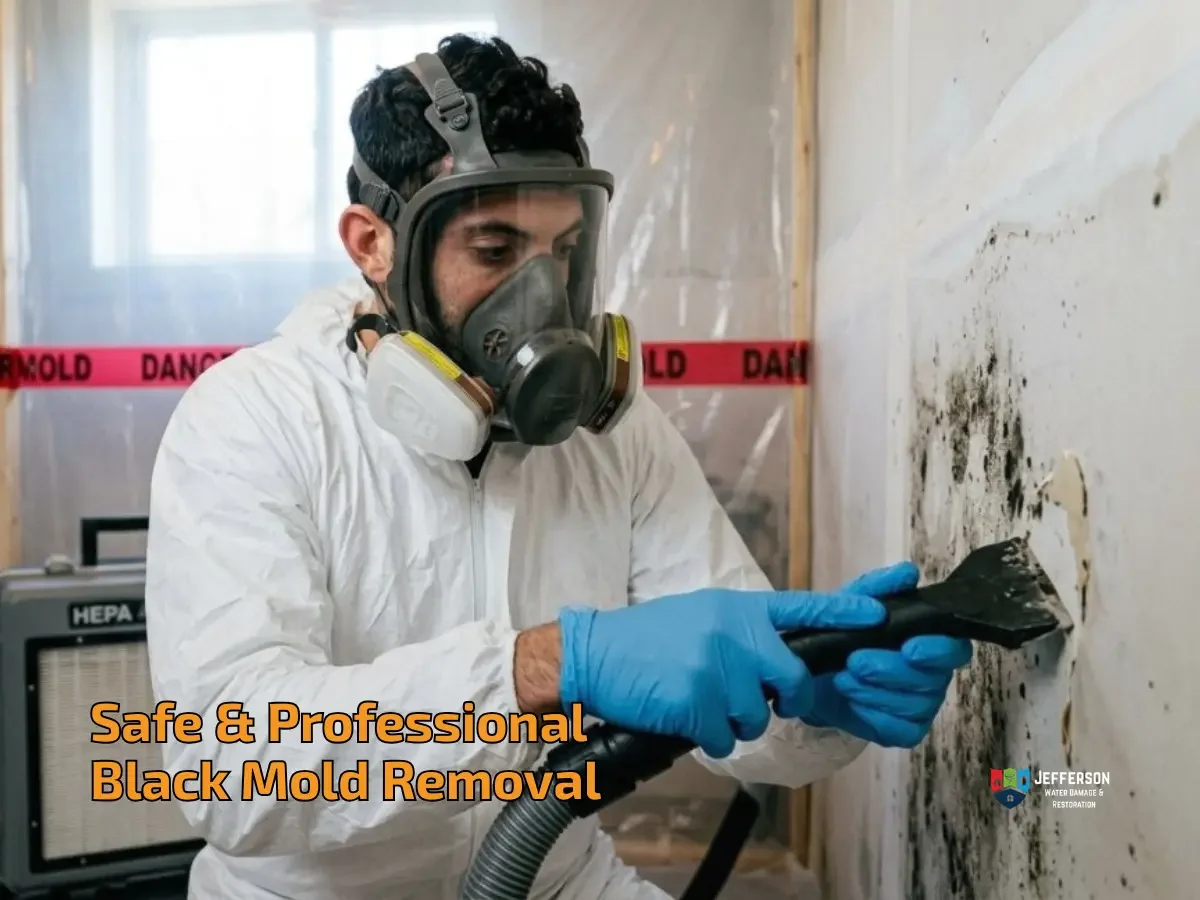
Black mold does not always announce itself visibly. A persistent musty odor, especially in basements or bathrooms, often indicates hidden mold growth inside walls or under flooring. Peeling or bubbling paint, warped drywall, and dark discoloration on ceilings or grout lines are visible signals worth taking seriously.
One of the clearest indicators is how you feel at home versus away from it. Respiratory symptoms, coughing, sneezing, headaches, and fatigue, that improve when you leave the property and return when you come back suggest mold exposure inside the building. Children, elderly residents, and anyone with compromised immune function are particularly sensitive.
Black mold, often Stachybotrys chartarum, typically appears as dark greenish-black patches with a slimy or powdery texture. It is distinct from the white or gray surface mold common in bathrooms. However, visual identification is not reliable enough to skip a professional assessment. Other mold species can look similar, and what appears on the surface of a wall often represents far more growth inside.
If you detect visible growth or a persistent odor after a pipe failure or flooding event, contact us for an inspection before the problem spreads. Water extraction handled quickly reduces the window in which mold can establish itself significantly.
Our Black Mold Remediation Process in Philadelphia
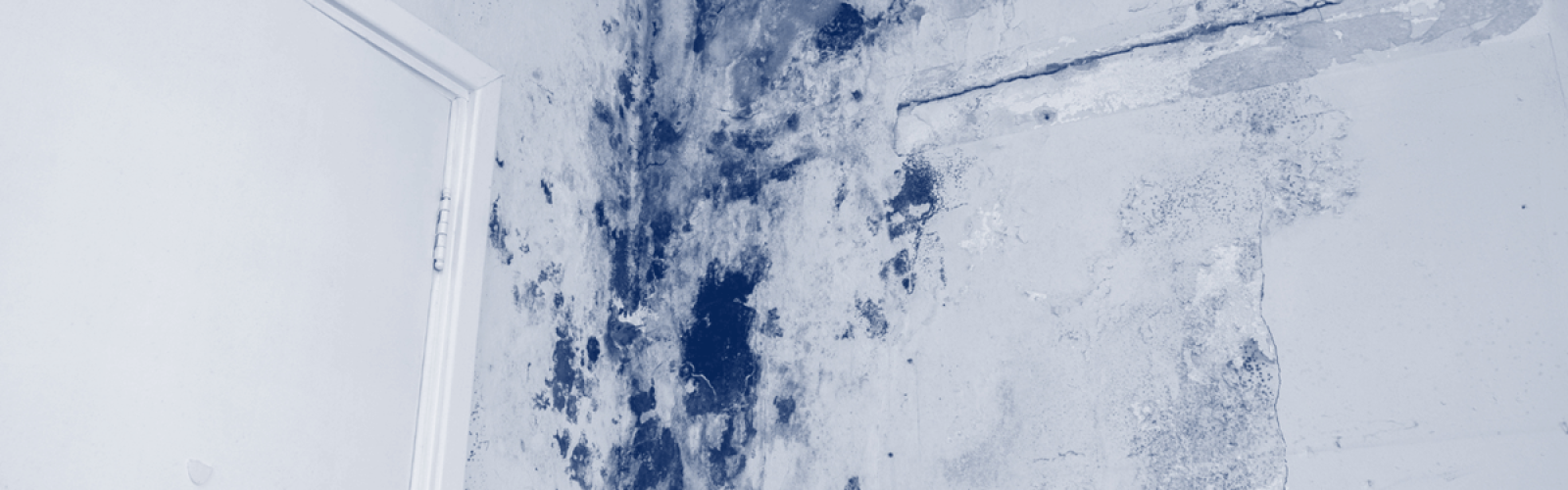
Every black mold remediation job follows a structured process based on IICRC S520 standards. Here is what happens from the moment we arrive.
Inspection and Moisture Source Identification
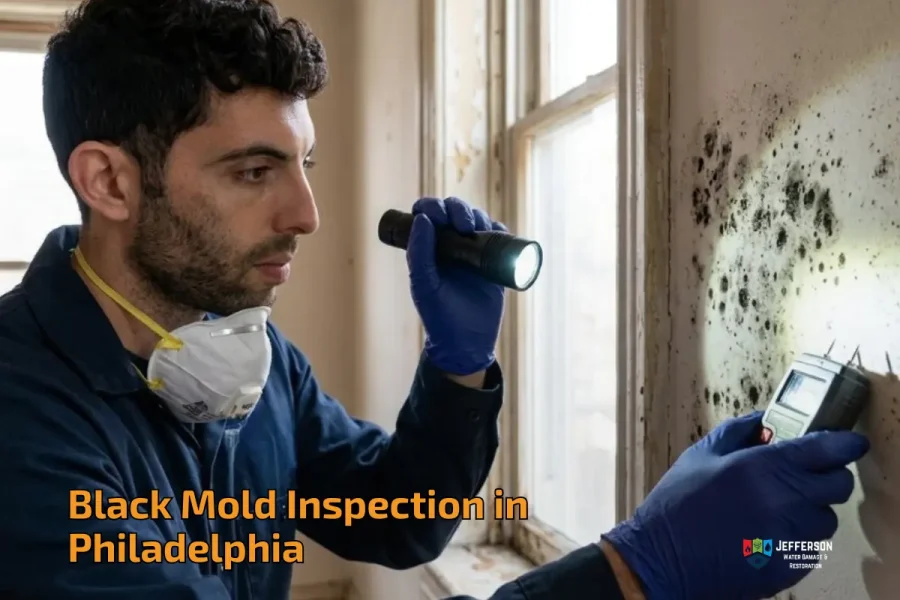
We begin with a thorough inspection using thermal imaging cameras and moisture meters. These tools locate moisture inside walls, under floors, and above ceilings without requiring demolition. Finding the moisture source is not optional, mold always returns if the source is not resolved. If we identify a plumbing issue during inspection, our leak detection and burst pipe repair services address the root cause as part of the same project.
Containment
Before any mold is disturbed, we seal off the affected area using plastic barriers and establish negative air pressure systems. This keeps mold spores from traveling to unaffected rooms during the removal process. In Philadelphia rowhouses with open floor plans or older HVAC ductwork, containment is especially important because spores move easily through connected spaces.
HEPA Air Filtration and Scrubbing
Industrial HEPA air scrubbers run continuously during remediation to capture airborne mold spores and improve indoor air quality. HEPA vacuums remove spores from surfaces before wet cleaning begins. This step protects both our technicians and any occupants in unaffected parts of the building.
Mold Removal and Material Disposal
Depending on the level of damage, porous materials including drywall, subfloor sections, and insulation may need removal. We bag and dispose of contaminated materials according to applicable standards. In some cases, structural elements like floor joists or wall framing require treatment or replacement. We handle repairs in-house, so you do not need a separate contractor to rebuild after remediation.
Antimicrobial Treatment
After physical removal, we apply antimicrobial agents to treated surfaces to eliminate remaining spores and inhibit future growth. This step is applied to all structural surfaces in the affected area, not just where visible mold was present.
Clearance Documentation
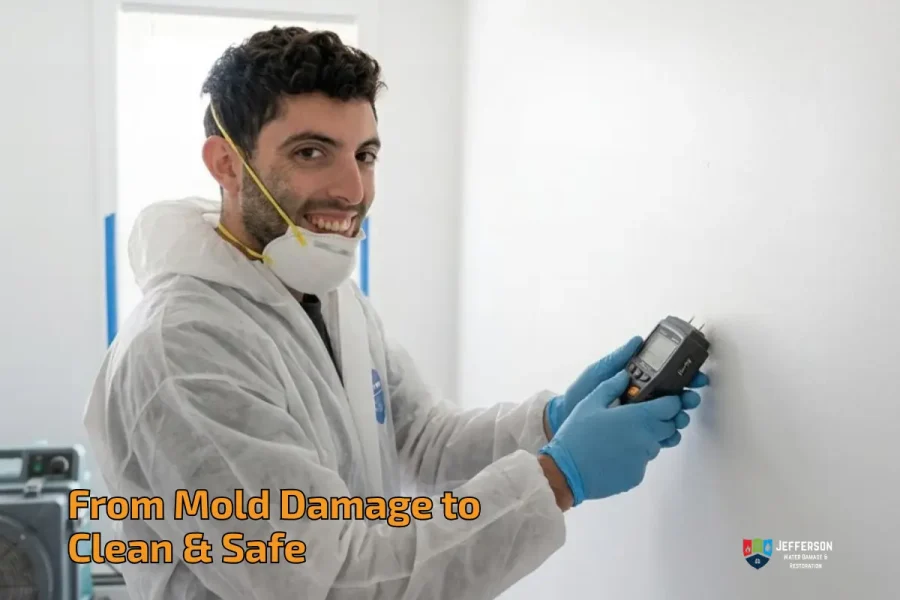
Once remediation is complete, we document the finished work with photos, moisture readings, and a written summary. This documentation supports insurance claims and satisfies the requirements of Philadelphia Municipal Code §6-902 for real estate transactions where a mold inspection has been triggered. You receive a clear record of what was found, what was done, and what the conditions looked like afterward.
Black Mold Remediation Cost in Philadelphia
On average, mold remediation in Philadelphia costs around $2,500, with prices typically ranging between $1,300 and $3,700 depending on the scope of the problem. Most projects run $10 to $25 per square foot for standard surface and structural remediation.
Location in the home affects cost significantly. Basement mold removal typically costs $500 to $3,000, though costs rise when mold is hidden behind wood paneling or inside finished walls. Mold in HVAC systems requires specialized cleaning and typically runs $2,000 to $5,000, since contamination can spread through ductwork to the rest of the home if not addressed properly.
Older housing in Philadelphia, common in neighborhoods like Fishtown, South Philly, West Philly, and Manayunk, frequently includes plaster walls, brick masonry, and aging structural framing. Jefferson’s team is highly experienced in working with these types of homes and uses techniques that protect original materials while completely removing mold at its source.
Mold testing is free for most visual inspections. If lab sampling is required to confirm the type of mold or rule out hidden contamination, testing typically runs up to $300.
Some homeowners insurance policies cover mold remediation when it results from a covered peril like a burst pipe. Insurers typically deny claims when mold results from long-term neglect or a slow, undetected leak. Our technicians document moisture sources and damage thoroughly, giving your adjuster the clearest possible picture to support your claim.
Call us for a free on-site assessment before assuming what the job will cost. Online estimates are a good place to start, but every Philadelphia home is different. Jefferson Restoration provides certified mold remediation backed by our IICRC license. There are no surprises or inflated quotes.
Philadelphia Mold Laws: What Property Owners Need to Know
Philadelphia has a local mold ordinance that most homeowners and buyers are unaware of. Under Philadelphia Municipal Code §6-902, a buyer of a residential property must have a comprehensive mold inspection conducted by a licensed residential mold inspector if the home inspector identifies visible mold growth or water intrusion during the home inspection.
This requirement is specific to Philadelphia and has direct implications for both sellers and buyers in real estate transactions.
Pennsylvania currently has no statewide mold remediation laws, but Philadelphia’s local ordinance applies to all residential property sales within city limits.
If you are preparing to sell a home in Fishtown, Manayunk, or West Philadelphia and a home inspector notes moisture intrusion or visible mold, remediation and documentation must happen before the sale can proceed cleanly.
Renters also have recourse. If you see mold growth in your rental property anywhere in Philadelphia, you can report it to the city by calling 311.
License and Inspections will inspect the property at no charge and work with the landlord around compliance. Jefferson can provide full remediation documentation for both landlord compliance and real estate transactions.
Preventing Black Mold from Returning in a Philadelphia Home
Mold can return after remediation if the underlying conditions are not corrected. For Philadelphia homeowners, this means ongoing attention to a few specific vulnerabilities.
Keep indoor relative humidity below 50 percent. Above that threshold, mold can begin to grow on organic materials even without a visible water source. In rowhouse basements and ground-floor units along Girard Avenue or in Strawberry Mansion, this often requires a dehumidifier running seasonally. Improve ventilation in bathrooms and kitchens where moisture accumulates.
In shared-wall rowhouses, check for moisture migration through party walls after heavy rain or neighboring plumbing events.
Inspect flat roofs and parapet walls seasonally, especially in South Philadelphia and North Philadelphia neighborhoods where flat-roof rowhouses are common.
A small membrane failure can allow water to enter slowly over months before staining appears. Address any moisture source immediately rather than monitoring it. Commercial property owners across the city face similar risks, see our commercial water damage restoration services for businesses managing larger or multi-unit properties.
Why Choose Jefferson for Black Mold Removal in Philadelphia
Jefferson Water Damage & Restoration has worked in Philadelphia homes since 2016. We know the building stock across neighborhoods from Roxborough to Port Richmond, and we understand the specific challenges that come with pre-war construction, combined sewer systems, and shared masonry walls. Our technicians are IICRC-certified and trained specifically in mold remediation per S520 standards.
Most mold companies remediate and leave. We handle the full cycle: finding the moisture source, fixing it, remediating the mold, and restoring the structure. One company, one project, one bill. We also work directly with insurance companies and provide all documentation your adjuster needs, which matters when your claim depends on a clear paper trail.
We operate 24 hours a day, seven days a week. Mold problems discovered on a Saturday night or a holiday morning get the same response as those discovered on a Tuesday afternoon.
Our address is 443 W Girard Ave, Unit 3G, Philadelphia, PA 19123, and our crews are available throughout the city and surrounding counties in Bucks, Montgomery, Delaware, and Chester.
Call us now at (267) 641-0090 for a fast inspection and straightforward assessment of what you are dealing with.
Black Mold Abatement Throughout Greater Philadelphia
Jefferson Restoration provides black mold removal services throughout Philadelphia and the surrounding areas.
Whether you’re in a Center City high rise, a Fishtown rowhouse, a Chestnut Hill colonial, or anywhere in between, we’re here to help.
Philadelphia neighborhoods we serve: Center City, South Philadelphia, Northern Liberties, Fishtown, Kensington, Port Richmond, East Falls, Frankford, Manayunk, Roxborough, Chestnut Hill, Mount Airy, Germantown, West Philadelphia, University City, and all surrounding areas.
Surrounding areas: Upper Darby, Darby, Yeadon, Lansdowne, Drexel Hill, Havertown, Media, Chester, Cheltenham, Jenkintown, Abington, Norristown, Conshohocken, Bala Cynwyd, Ardmore.
Frequently Asked Questions About Black Mold Remediation in Philadelphia
How quickly can black mold grow after water damage?
Black mold can begin growing within 24 to 48 hours of water exposure, become visible in 3 to 7 days, and develop into a serious widespread problem within 2 to 3 weeks if moisture is not eliminated. If you have recently had a burst pipe, basement flood, or water extraction event, contact us for a mold assessment even before you see any visible growth.
Is black mold dangerous to my family's health?
Yes. Exposure causes respiratory problems, allergic reactions, and chronic conditions, with heightened risk for children, elderly residents, and immunocompromised individuals. Symptoms include coughing, sneezing, headaches, fatigue, and breathing difficulties. If your symptoms improve when you leave home but return when you come back, hidden mold may be the cause.
Does Philadelphia have special mold inspection laws?
Yes. Under Philadelphia Municipal Code §6-902, a buyer of a residential property must have a comprehensive mold inspection by a licensed inspector if visible mold growth or water intrusion is identified during the home inspection. Tenants can also report mold to the city by calling 311, and License and Inspections will conduct a free inspection and work with the landlord on compliance. Jefferson provides full remediation documentation for both real estate transactions and insurance claims.
Will homeowners insurance cover black mold remediation?
Coverage depends on the cause. Insurance typically covers mold remediation when it results from a covered peril like a burst pipe. Flood damage usually requires separate flood insurance. Mold from long-term neglect or a slow undetected leak is generally excluded. Our technicians document all moisture sources and damage thoroughly to give your adjuster the clearest possible picture to support your claim.
Can black mold come back after remediation?
Mold returns when the moisture source is not fully resolved. Jefferson’s process always includes identifying and correcting the source, whether a failing pipe, foundation crack, or ventilation problem. Using mold-resistant building materials during reconstruction and maintaining indoor humidity below 50 percent also reduces the chance of recurrence significantly.
How long does black mold remediation take?
A localized bathroom or basement job typically takes 1 to 3 days. Whole-house or HVAC-involved remediation with structural material removal can take 3 to 7 days or longer. We provide a clear timeline during the initial assessment. Because we respond 24/7, containment and inspection can begin the same day you call, which matters given mold’s ability to spread within 72 hours.
Stop
The Growth of Black Mold Now
Get a Free Professional Inspection
Local experts • Fast response • No hidden fees