
Crawl Space Mold Remediation in Philadelphia, PA
Worried about mold in your crawl space? Call us now at (267) 641-0090 for a free inspection. Available 24/7.
- 60 min response
- IICRC Certified #70209237
- We Handle Insurance
Request a Free Inspection
Local experts • Fast response • No hidden fees
If you smell something musty under your floors or your flooring feels soft in spots, your crawl space may already have a mold problem. Philadelphia’s older housing stock, rowhouses, trinity homes, flat-roof twins, creates conditions where crawl space mold builds quietly for months before anyone notices.
Jefferson Water Damage & Restoration Philadelphia responds 24/7 from 443 W Girard Ave in Philadelphia, with IICRC-certified technicians trained for confined-space mold remediation. Call (267) 641-0090 for a free on-site inspection.
Why Philadelphia Crawl Spaces Are Especially Vulnerable to Mold
Philadelphia’s housing creates crawl space conditions that most national restoration guides never address. Rowhouses in Fishtown, Kensington, Point Breeze, Brewerytown, and Germantown were built before modern insulation and vapor control standards existed. Their crawl spaces are uninsulated, poorly ventilated, and in direct contact with soil that shifts through every freeze-thaw cycle.
When seasonal moisture saturates the ground beneath a rowhouse or flat-roof twin, that moisture rises into the structure and has nowhere to go.
Attached rowhouses also share foundation walls. Moisture migrating through one home can move laterally into adjacent properties. Trinity homes in Queen Village and Old City, pre-war brownstones along Girard Avenue in Brewerytown, and colonial twins in the Northeast all share the same core vulnerability: water gets in, and the structure holds it.
Philadelphia’s location between the Delaware and Schuylkill Rivers keeps ambient humidity elevated throughout the year. In summer months, outdoor relative humidity routinely exceeds 60 percent, the threshold above which mold actively grows on organic materials like wood framing and subfloor decking.
That creates two distinct mold seasons in this region: a summer peak from June through September, and a secondary wave in March through May as snowmelt saturates soil beneath crawl spaces. Pipe-burst events from January and February freezes are a major trigger. What registers as minor dampness in winter often shows as visible mold growth by spring.
For homes that have experienced standing water beneath the floor, crawl space water damage and debris removal is the necessary first step before any mold remediation can begin.
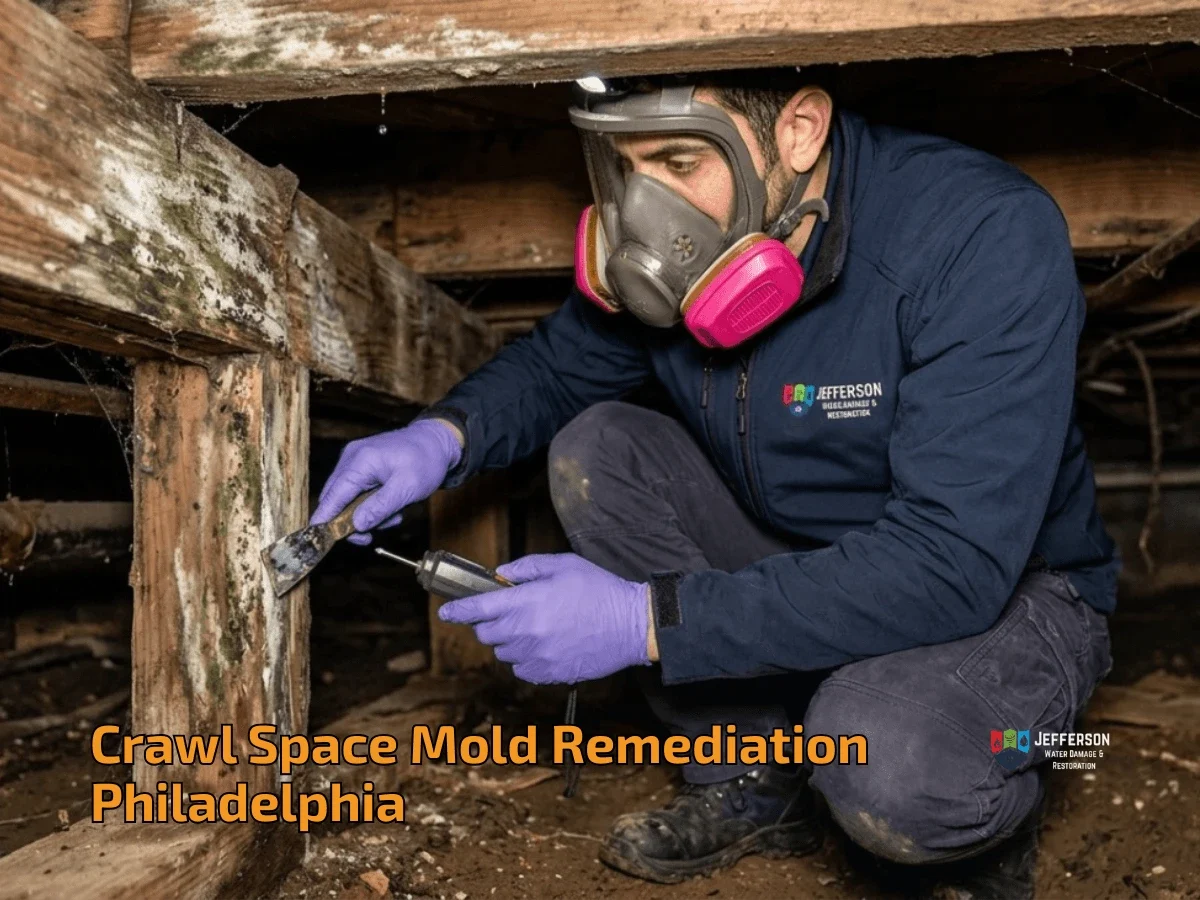
Signs You Have Mold in Your Philadelphia Crawl Space
A persistent musty odor is one of the first indicators. It tends to be strongest near floor vents, baseboards, and closets on the ground floor. If the smell worsens in humid weather, a crawl space moisture problem is likely the source.
Soft or spongy flooring above the crawl space is a structural warning sign: It indicates that floor joists or subfloor decking have absorbed moisture long enough to begin deteriorating.
This level of damage requires mold remediation and likely structural repair before the flooring above is replaced.
Worsening allergy or respiratory symptoms indoors, particularly in spring and summer, point to airborne mold spores entering the living space.
The stack effect pulls air upward from the crawl space through gaps in flooring, carrying spores into every room above. Mold in a crawl space that is never entered still continuously affects air quality on every floor of the home.
Visible dark staining on wood framing, insulation that appears discolored or compressed, and water staining on foundation walls are all signs that mold is already established. If any of these are present, professional mold testing and air quality clearance confirms the extent of contamination before remediation begins.
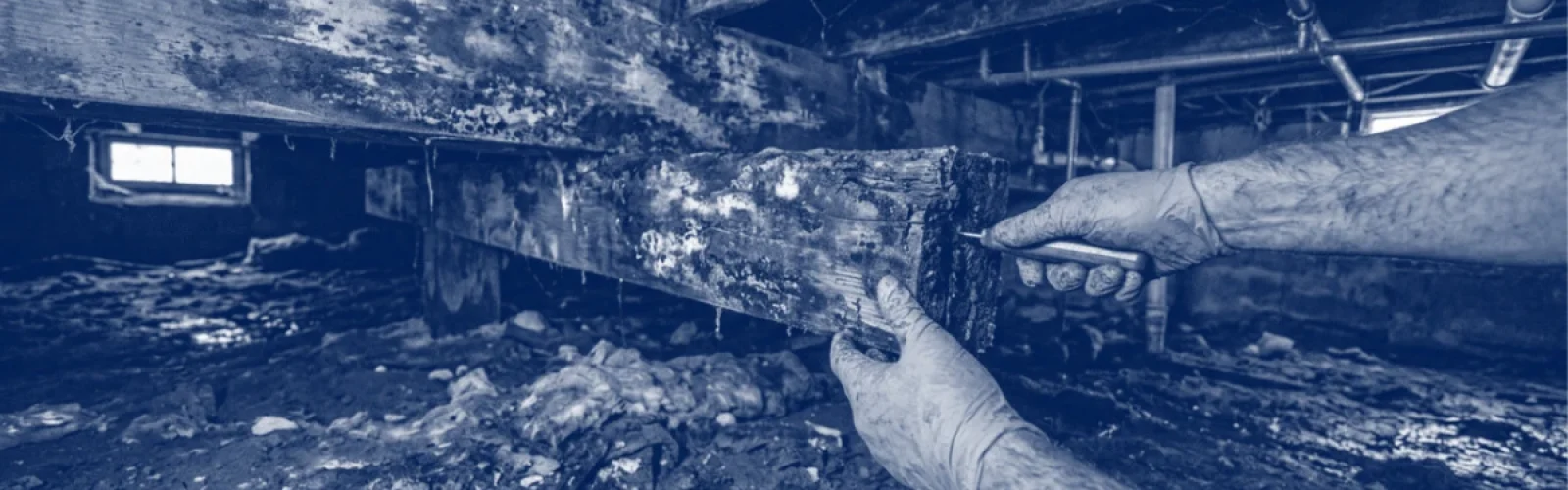
Our Crawl Space Mold Remediation Process, Step by Step
Of all the types of mold remediation in a home, the crawl space is the most difficult working environment. Low clearance, confined access points, and compromised structural materials require technicians who are specifically trained for these conditions. Jefferson’s IICRC-certified crews follow a full remediation protocol, not a surface wipe-down.
Step 1, Thermal Imaging and Moisture Assessment
Technicians use thermal imaging cameras and calibrated moisture meters to map hidden moisture in floor decking, framing, and subfloor material. This assessment identifies the full contamination zone, including areas with no visible mold but elevated moisture that supports active growth.
Step 2, Containment with Negative-Air HEPA Scrubbers
Before any disturbing of mold begins, containment barriers are established to seal the work area. Negative-air HEPA scrubbers maintain pressure differentials that prevent spores from migrating into living spaces during remediation. This step is non-negotiable on any properly scoped job.
Step 3, Insulation Removal and HEPA Vacuuming
Insulation between floor joists must be removed, bagged, and taken out of the space. It cannot be dried and reused once it has absorbed moisture and harbored mold growth. Once removed, all exposed joists and subfloor surfaces are HEPA-vacuumed to remove loose spores before treatment begins.
Step 4, Mechanical Scrubbing and Antimicrobial Treatment
Technicians mechanically scrub treated surfaces to remove embedded mold from wood grain. An EPA-registered biocide is then applied to all affected structural wood. This step addresses mold at the surface and penetrates into the material rather than simply coating over growth.
Step 5, Structural Drying
Industrial air movers and commercial dehumidifiers run until moisture readings in framing and subfloor material reach target levels. Drying is verified with daily moisture meter readings, not estimated by time elapsed.
Step 6, Independent Post-Clearance Air Testing
Skip any contractor that omits post-remediation air testing. Without it, there is no proof the remediation worked. Jefferson coordinates with an independent third-party tester for clearance documentation. That report belongs to you, it confirms spore counts have returned to acceptable levels before we close the job.
Step 7, Moisture Control Advisory
Before the crew leaves, we provide specific recommendations for keeping moisture out of the crawl space going forward. That includes vapor barrier options, vent sealing, dehumidifier sizing (50-70 pint per day units are standard for Philadelphia crawl spaces), and pipe insulation for homes vulnerable to freeze events.
For full-property mold remediation services when contamination extends beyond the crawl space, Jefferson handles the entire scope under one project.
Crawl Space Mold Remediation Cost in Philadelphia
Crawl space mold remediation in Philadelphia typically costs $550 to $4,200. Pricing depends on the contamination area, the mold species present, and whether structural materials require replacement. Black mold (Stachybotrys) requires full containment protocols and carries higher labor and disposal costs than common surface mold species.
For jobs that also require encapsulation (sealing the crawl space with a vapor barrier to prevent moisture and future mold growth), total costs typically run $1,500 to $5,000 for remediation alone, with full encapsulation adding $3,000 to $6,000 more. Average projects that include both remediation and a vapor barrier run $3,500 to $5,500 for most Philadelphia homes.
Philadelphia-specific cost factors include tight rowhouse access points that increase labor time, and older construction materials that may require additional assessment before work begins. These are variables we account for in the initial estimate — not surprise charges added mid-job.
On insurance: pipe-burst water damage is widely covered in Pennsylvania, including resulting mold growth. File within your policy’s notice window, which typically runs 14 to 60 days depending on the carrier. Mold caused by groundwater, humidity, or drainage failure is considered a maintenance issue and is generally excluded from standard coverage.
Jefferson provides full documentation and coordinates directly with adjusters where coverage applies. When the damage trail begins with a pipe failure, see our pages on water damage restoration and burst pipe repair in Philadelphia for related coverage.
Call (267) 641-0090 for a free on-site estimate — no surprises, no inflated quotes.
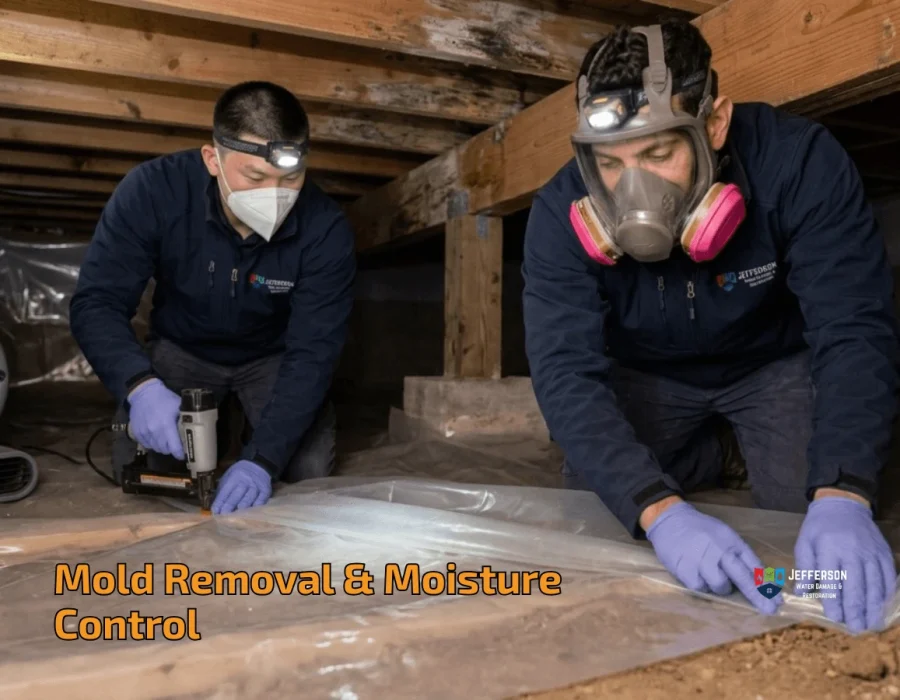
Crawl Space Mold Remediation vs. Crawl Space Cleanup, What Is the Difference?
This distinction matters because the two services address different problems, and confusing them leads to incomplete work.
Crawl space cleanup covers the broader restoration after a water, flooding, or sewage event: removing standing water, debris, saturated insulation, and contaminated materials, including surface-level mold treatment as part of the overall cleanup. It is the right response after a pipe burst, basement flood, or sewage backup cleanup that reached the crawl space.
Crawl space mold remediation is a mold-specific protocol. It requires HEPA containment with negative-air pressure, mechanical scrubbing and HEPA vacuuming of structural wood, EPA-registered antimicrobial treatment of floor joists and subfloor material, structural drying verified by moisture meters, and post-clearance air testing by an independent third party. This protocol applies when mold has colonized the structure, regardless of whether active water is still present.
When both problems exist, the sequence matters. Crawl space cleanup after water damage or flooding must be completed and the structure verified dry before mold remediation begins. Attempting remediation in an area that still holds moisture produces incomplete results. If emergency water extraction is needed first, Jefferson handles that step as part of the same project so no time is lost between phases.
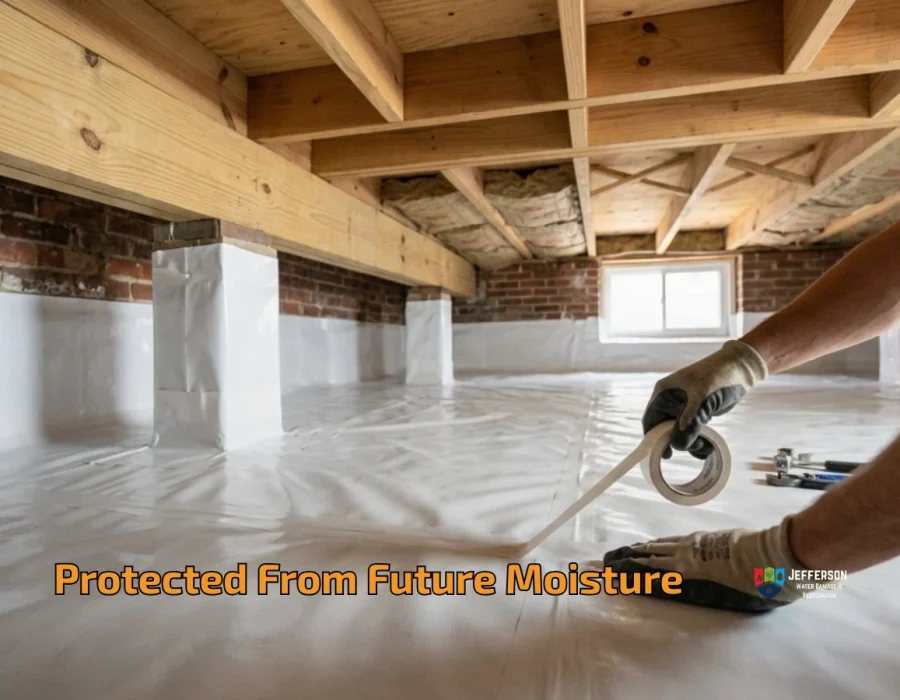
Preventing Crawl Space Mold From Returning, What Philadelphia Homeowners Should Know
Mold returns when moisture returns. Without active moisture control, mold growth in a remediated Philadelphia crawl space typically recurs within one to three years. The remediation removes the existing colony; moisture management prevents the next one.
The primary target is relative humidity. Crawl spaces in Philadelphia should maintain relative humidity below 55 percent year-round. A dedicated 50 to 70 pint per day dehumidifier achieves this in most rowhouse and twin-home crawl spaces. A vapor barrier is the second layer of defense, minimum 6-mil polyethylene, though 12 to 20-mil is preferred for Philadelphia’s clay soil conditions and the movement that comes with freeze-thaw cycles. Seams must be overlapped and sealed, not simply laid adjacent.
Vent sealing in conditioned crawl spaces reduces the introduction of outdoor humid air during summer months. Pipe insulation is a practical step in homes with plumbing running through unheated crawl space areas, where freeze events are a recurring mold trigger.
There is also a pest connection worth noting. Moisture attracts insects, ants, roaches, and termites are drawn to wet organic material. Reducing crawl space humidity eliminates conditions that attract these insects as a secondary benefit of moisture control.
Philadelphia crawl spaces should be inspected every four to five years after remediation to confirm the vapor barrier and dehumidification systems remain functional. Use professional leak detection to identify moisture sources if humidity levels rise again between inspections. For homes where moisture has migrated from the crawl space into adjacent basement areas, basement mold remediation may be needed as part of the same moisture control plan.
How Jefferson Restoration Works?
01
Immediate Response
24/7 emergency dispatch
02
Free Assessment
Transparent inspection and estimate
03
Insurance Coordination
We work directly with your provider
04
Restoration & Repair
From damage control to complete rebuild
Why Philadelphia Homeowners Choose Jefferson for Crawl Space Mold Remediation
Jefferson handles the full job from the first call through post-clearance documentation. That means one crew, one invoice, and no waiting for a second contractor to pick up where the first one stopped. IICRC-certified technicians work every job, certification number 70209237, and the protocols follow IICRC S520 standards for mold remediation.
We are available 24 hours a day, seven days a week. Crawl space mold does not require an emergency call at 2 AM, but the initial inspection often reveals water damage or structural concerns that do. We are ready regardless of when you call.
Our location at 443 W Girard Ave Unit 3G, Philadelphia, PA 19123 puts us near the Fairmount and Northern Liberties border, with crews that reach neighborhoods across the city: South Philadelphia, University City, Germantown, Roxborough, Manayunk, Chestnut Hill, Olney, Frankford, Port Richmond, Northeast Philadelphia, and surrounding communities in Montgomery, Delaware, and Bucks counties.
Free on-site estimates before any work begins. Clear pricing before any work starts. Insurance documentation prepared and submitted on your behalf where coverage applies. Call Jefferson at (267) 641-0090 to schedule your inspection.
Mold Remediation Throughout Greater Philadelphia
Jefferson Restoration provides mold removal services throughout Philadelphia and the surrounding areas. Whether you’re in a Center City high rise, a Fishtown rowhouse, a Chestnut Hill colonial, or anywhere in between, we’re here to help.
Philadelphia neighborhoods we serve: Center City, South Philadelphia, Northern Liberties, Fishtown, Kensington, Port Richmond, Frankford, Manayunk, Roxborough, Chestnut Hill, East Falls, Mount Airy, Germantown, West Philadelphia, University City, and all surrounding areas.
Surrounding areas: Upper Darby, Darby, Yeadon, Lansdowne, Drexel Hill, Havertown, Media, Chester, Cheltenham, Jenkintown, Abington, Norristown, Conshohocken, Bala Cynwyd, Ardmore.
Frequently Asked Questions, Crawl Space Mold Remediation in Philadelphia
How long does crawl space mold remediation take?
Remediation alone typically takes two to four days. Adding a vapor barrier extends the timeline to four to five days. Full encapsulation takes five to seven days. Older Philadelphia rowhouses with irregular framing or very low clearance may require additional time, which Jefferson accounts for in the initial assessment.
Does homeowners insurance cover crawl space mold remediation in Pennsylvania?
It depends on the cause. Pipe-burst water damage is widely covered, including resulting mold, if filed within the policy’s notice window, typically 14 to 60 days. Mold from groundwater, humidity, or drainage failure is generally excluded as a maintenance issue. Check your policy’s sewer and drain backup rider for sump pump failure coverage. Jefferson assists with documentation and adjuster communication where coverage applies.
Can crawl space mold affect indoor air quality?
Yes. The stack effect pulls air from the crawl space upward through gaps in flooring and into living areas, carrying mold spores into every room above. Of the 21.8 million people who suffer from asthma in the United States, 4.6 million cases are caused by mold exposure at home. A crawl space that is never entered can still continuously affect the air quality throughout the entire home.
Is crawl space mold remediation something I can do myself?
It is not recommended. Crawl spaces require respiratory protection, proper containment to prevent spore migration, and verified post-remediation air testing. The EPA recommends professional remediation for mold areas exceeding 10 square feet. Most Philadelphia crawl space infestations, particularly those affecting floor joists and insulation across the full underfloor area, far exceed that threshold.
Stop
Mold Growth Now
Get a Free Professional Inspection
Local experts • Fast response • No hidden fees