Emergency Water Extraction in Philadelphia, PA, Available 24/7
Emergency water extraction and structural drying for homes and businesses across Philadelphia. Call us now at (267) 641-0090 and we will be there.
- 60 min response
- IICRC Certified #70209237
- We Handle Insurance
Request a Free Inspection
Local experts • Fast response • No hidden fees
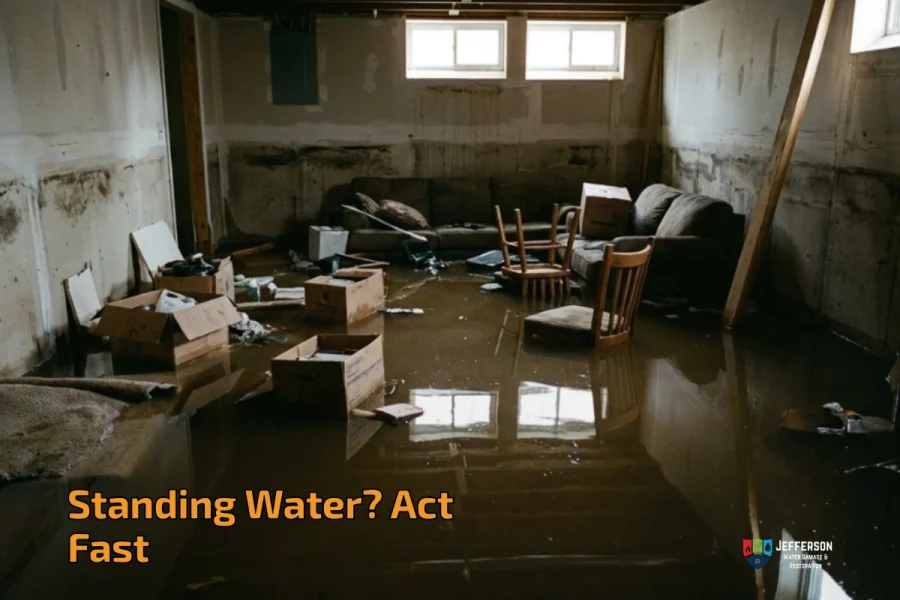
Standing water in your home causes damage by the hour. Floors warp, walls absorb moisture, and mold begins growing within 24 to 48 hours of exposure.
Jefferson Water Damage & Restoration Philadelphia dispatches IICRC-certified technicians immediately, day or night, to extract standing water, stop the damage, and protect your property. Call us now at +1 267 641-0090.
Philadelphia's 24/7 Emergency Water Extraction Team
Jefferson operates from 443 W Girard Ave in Northern Liberties, giving us fast access to every Philadelphia neighborhood around the clock.
Our technicians carry commercial extraction equipment on every truck and respond to water emergencies 365 days a year, including holidays. There is no call center, no national routing system, and no waiting until morning.
When you call about standing water, we dispatch immediately. Our IICRC certification number is 70209237, and every technician on our team follows the S500 standard for water damage response.
We also handle insurance documentation from the first day on-site, so your claim moves forward while we work. If your home has a flooded basement, that is one of the most common calls we receive and one we handle thoroughly every time.
Why Fast Water Removal Matters in Philadelphia Homes
Philadelphia presents specific flood risks that most cities do not share. The city sits between the Delaware and Schuylkill rivers, and large sections of Philadelphia fall within FEMA flood zones AE, AO, and X. FEMA’s National Risk Index estimates Philadelphia County’s annual expected loss from inland flooding at over $266.1 million. Philadelphia County has also been included in 13 federal flood-related disaster declarations.
The city’s aging combined sewer system amplifies the risk. During heavy rain events, stormwater and sewage share the same underground pipes. When those pipes reach capacity, the overflow backs up into homes through floor drains and basement toilets across neighborhoods from Kensington to Grays Ferry. The Philadelphia Water Department has documented this problem for decades, yet the infrastructure remains a recurring source of residential water damage.
Philadelphia’s rowhouse stock adds another layer of complexity. Most of the city’s homes were built before 1950 with shared party walls and common foundations. Water from a burst pipe in one unit travels laterally through those shared structures into adjacent properties. What looks contained to one home often is not. If you are dealing with unexplained moisture and no obvious source in your own unit, professional leak detection is the right starting point.
From a physical standpoint, removing liquid water through direct extraction is at least 500 times more efficient than relying on dehumidifiers and air movers alone. Equipment can only evaporate water. Extraction removes it. The faster standing water leaves your property, the shorter the drying process and the lower the total restoration cost.
Jefferson's Water Extraction Process, Step by Step
Every job follows the same structured sequence. This is not a shortcut-based approach. Each step is required by the IICRC S500 standard and produces documented results your insurance company can verify.
Emergency Dispatch and Arrival
We answer every call 24 hours a day and dispatch a crew immediately. Our teams leave from our Girard Avenue location and reach most Philadelphia addresses within an hour.
You receive a direct line to the technician heading your way, not a hold queue.
Damage Assessment and Water Classification
On arrival, we identify the water source and classify the contamination level using the IICRC S500 framework.
Category 1 water comes from clean supply lines and faucet failures.
Category 2 gray water originates from appliance overflows and toilet overflows without fecal matter.
Category 3 black water includes sewage backups, river flooding, and any standing water left untreated beyond 48 hours. The category determines our safety protocols, the scope of material removal, and your restoration cost. We explain the classification clearly before work begins.
Standing Water Extraction
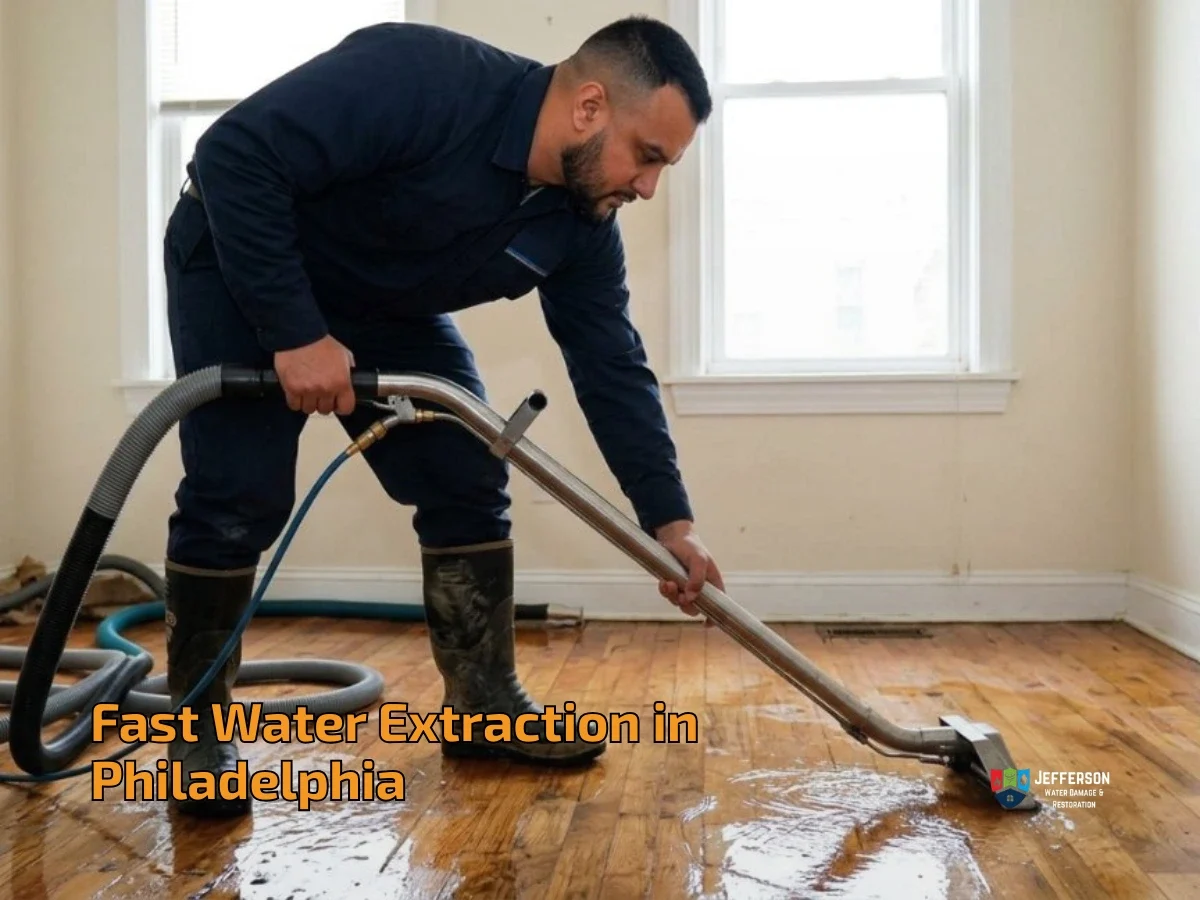
Portable extractors reach tight spaces in rowhouse utility rooms and narrow hallways. Submersible pumps address deep basement flooding. For carpeted areas, weighted extraction tools press into the pile and pull water out of both the carpet and the padding below, often without requiring removal if addressed quickly enough.
For burst pipe situations, our burst pipe repair team addresses the source while extraction proceeds simultaneously.
Moisture Detection Behind Walls and Under Floors
Standing water visible on the floor is rarely the full picture.
Thermal imaging cameras reveal temperature differences in wall cavities and subfloor systems where water has migrated but is not yet visible.
Penetrating moisture meters confirm the depth of saturation in framing, drywall, and flooring materials. In Philadelphia rowhouses, we always inspect party walls where water commonly travels into adjacent units without either homeowner realizing it.
Structural Drying and Dehumidification
Industrial air movers create directed airflow across wet surfaces, pulling moisture out of materials and into the air.
Commercial dehumidifiers then capture that moisture before it can settle into other areas of your home.
We monitor moisture readings daily and adjust equipment placement based on the numbers, not guesswork. A typical residential job requires several days of continuous drying before materials return to acceptable moisture levels.
Antimicrobial Treatment
Category 2 and Category 3 water damage requires antimicrobial application to prevent bacterial growth and mold colonization during the drying period.
We apply EPA-registered treatments to all affected surfaces after extraction.
If existing mold is present at the time of our assessment, our mold remediation team addresses it as part of the same project with no delay waiting for another contractor.
Documentation and Insurance Coordination
We photograph damage before, during, and after every phase of work. Moisture readings are logged daily.
Material inventories and scope-of-work records are formatted to meet insurance adjuster requirements.
We communicate directly with your carrier throughout the process so you do not have to translate between your restoration team and your adjuster.
Water Extraction for Every Philadelphia Property Type
Rowhouse and Townhome Water Extraction
Philadelphia’s attached rowhouses present challenges that freestanding homes do not. Shared foundations and party walls allow water to migrate between units. Older clay drain tiles under basements crack and allow groundwater intrusion along the entire block. Our technicians inspect beyond the visible damage boundary on every rowhouse job because stopping at the property line misses half the problem.
Basement Water Extraction
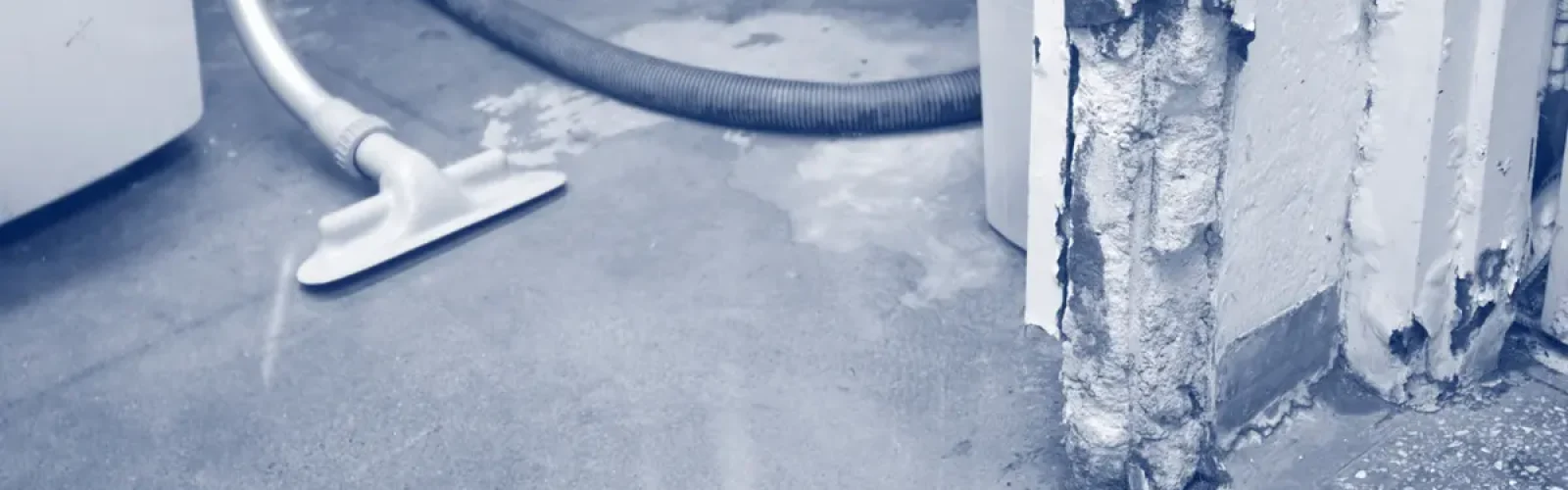
Basement flooding from sump pump failures, sewer backups, and storm overflow is among the most common calls we receive across every Philadelphia neighborhood. Below-grade spaces concentrate water quickly and stay wet long after the event because air circulation is poor. For thorough information on the full cleanup process, our basement flood cleanup page covers what to expect from start to finish.
Carpet and Hardwood Floor Extraction
Carpet and padding can often be saved with rapid weighted extraction if we reach the site within the first few hours. Hardwood floors are more sensitive. Philadelphia rowhouses often contain original hardwood that cups and warps when moisture penetrates the subfloor. We use floor drying mats and penetrating meters to assess whether in-place drying is viable or whether removal is necessary. We give you an honest answer either way.
Ceiling and Wall Cavity Water Removal
Pipe failures inside wall cavities and roof leaks above finished ceilings trap water in spaces that never dry on their own. Thermal imaging locates the moisture pocket, and controlled access points allow drying equipment to reach the cavity without unnecessary demolition. For homes where the source is unknown, hidden leak detection identifies the exact origin before we open anything.
Commercial Property Water Extraction
Offices, retail spaces, multifamily buildings, and mixed-use properties across Philadelphia require fast extraction to minimize business interruption and tenant displacement. Our commercial water damage restoration service addresses large-scale events with the same documented process we apply to residential work.
Water Damage Restoration Equipment and Technology
Professional water damage restorationrequires specialized equipment that most homeowners and general contractors do not have access to.
Here is what we bring to every job.
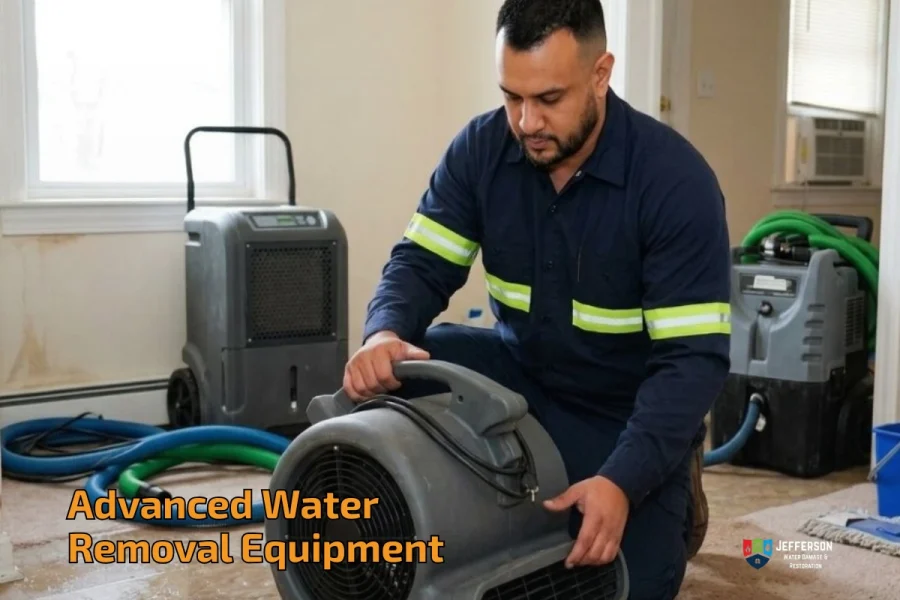
Thermal imaging cameras let us see moisture inside walls and ceilings without cutting them open. Water shows up as temperature differences on the thermal image, revealing the full extent of damage that is invisible to the naked eye.
Moisture meters and hygrometers measure water content in materials and humidity levels in the air. We use these tools to determine when an area is truly dry, not just when it feels dry to the touch.
Portable water extractors use powerful suction to remove standing water from affected floors and surfaces. Their compact design allows our technicians to work in tight spaces, including narrow basements commonly found in Philadelphia rowhouses. For larger volumes of standing water, we also use submersible pumps when appropriate.
Industrial air movers and commercial dehumidifiers work together to dry structures quickly. A typical residential water damage job might require 10 to 20 air moversand multiple dehumidifiers running continuously for several days.
HEPA air scrubbers filter mold spores, dust, and other particles from the air during the restoration process, protecting both our technicians and your family.
Water Extraction Cost in Philadelphia, What to Expect
Emergency water extraction in Philadelphia typically ranges from $500 to $3,000 for residential properties, depending on water volume, affected square footage, water category, and structural damage extent. Full restoration, including drying and repairs, averages around $3,800, with most homeowners spending between $1,400 and $6,400. On a per-square-foot basis, expect $3.50 to $7.50 depending on the water category involved.
Category 1 clean water damage runs approximately $3.75 to $7.00 per square foot. This is the most common type — clean water from broken supply lines, overflowing sinks, or rainwater intrusion.
Category 2 gray water ranges from $4.00 to $8.00 per square foot due to the additional sanitization required. This includes water from dishwashers, washing machines, or sump pump overflows.
Category 3 black water, including sewage backups common in Philadelphia’s CSO-affected neighborhoods like Fishtown, Port Richmond, and South Philly, costs $7.00 to $12.00 per square foot because contaminated materials require removal and the area requires thorough disinfection.
Acting fast keeps costs at the lower end of every range. Every additional hour of standing water drives moisture deeper into framing and subfloor systems, adding drying time, material replacement scope, and mold risk. Same-day extraction is almost always the most affordable path to full restoration.
Homeowners insurance usually covers sudden and accidental water damage, such as from burst pipes or appliance failures. Jefferson works directly with all major insurance companies and provides the documentation that adjusters need to accurately process claims. We offer a free on-site assessment so you know the full scope of the work before it begins. There are no surprise charges or inflated estimates.
Why Philadelphia Homeowners Choose Jefferson for Water Extraction
Jefferson is not a national franchise. We are a Philadelphia-based team at 443 W Girard Ave, licensed and IICRC certified, with more than 10 years working in the city’s specific housing conditions. When you call us, a local technician answers. When we dispatch, the crew comes from within the city, not from a regional hub two counties away.
Our customers describe the experience in their own words: “attention to detail is phenomenal” and “ensured everything was dry and safe.” These are not vague service promises. They reflect a process built around daily moisture monitoring, clear communication at each stage, and a job that is not finished until readings confirm the property is genuinely dry.
We handle the full project from first extraction through final repair. You work with one team, receive one itemized estimate, and deal with one point of contact for your insurance company. When the job is complete, your home is restored, not just dried.
For emergency water extraction in Philadelphia, call Jefferson at +1 267 641-0090. We answer 24 hours a day and dispatch immediately.
Philadelphia Neighborhoods Jefferson Serves for Water Extraction
Our Girard Avenue location places us minutes from Northern Liberties, Fishtown, Old City, Spring Garden, and Fairmount. From there, our crews reach every corner of Philadelphia quickly.
We serve Center City, Rittenhouse Square, Logan Square, and Washington Square West.
North Philadelphia neighborhoods including Brewerytown, Strawberry Mansion, Kensington, and Port Richmond are part of our regular service area. We respond to calls from Germantown, Mount Airy, Chestnut Hill, Manayunk, Roxborough, and East Falls in the northwest.
Northeast Philadelphia, including Mayfair, Oxford Circle, Holmesburg, Bustleton, Somerton, Torresdale, and Rhawnhurst, is well within our response range.
West Philadelphia neighborhoods including University City, Powelton Village, Spruce Hill, Cedar Park, Cobbs Creek, and Overbrook are also covered.
South Philadelphia, including East Passyunk, Pennsport, Queen Village, Bella Vista, Point Breeze, and Grays Ferry, receives the same fast response as any other part of the city.
We also serve surrounding communities including Upper Darby, Cheltenham, Abington, Jenkintown, Bala Cynwyd, Havertown, Drexel Hill and Lansdowne. If your property is in the Greater Philadelphia area and you have standing water, we respond.
Frequently Asked Questions About Water Extraction Services
How quickly can Jefferson respond to a water extraction emergency in Philadelphia?
Jefferson is available 24 hours a day, 7 days a week, 365 days a year. We dispatch immediately from our 443 W Girard Ave location. Response times vary by neighborhood, but our goal is to be on-site as quickly as possible because every minute of standing water causes additional damage. Call the moment you discover standing water.
Does homeowners insurance cover water extraction?
Homeowners insurance typically covers sudden, accidental events such as burst pipes and appliance failures. Gradual leak damage and external flood damage from rivers or storm surge are generally handled differently. Flood damage usually requires a separate NFIP or private flood policy. Jefferson documents your loss thoroughly with photos, moisture readings, and drying logs to support your claim with any carrier.
How long does the water extraction and drying process take?
A water-damaged home typically takes around five days to dry, with extraction requiring at least three days and full restoration potentially taking weeks depending on the scope of damage. The timeline depends on the volume of water, the materials affected, and the water category. Jefferson monitors moisture levels daily and does not pack up equipment until readings confirm your property is fully dry.
My Philadelphia rowhouse shares walls with a neighbor. Can water migrate between units?
Yes, and this is one of the most important reasons to use thermal imaging during every extraction job. Water travels through shared party walls, common foundations, and shared drain systems. A burst pipe in your neighbor’s unit can create hidden moisture in yours, and vice versa. Jefferson’s technicians inspect party walls and common areas on every rowhouse job. If you suspect a neighbor’s water problem is affecting your home, call us for an assessment.
Can water extraction save my hardwood floors or carpet?
Often yes, but timing determines the outcome. Carpet and padding can frequently be saved with weighted extraction if addressed within the first few hours. Hardwood floors require moisture assessment with penetrating meters to determine whether in-place drying is viable. Porous materials that cannot be thoroughly dried or sanitized, including saturated drywall, carpet padding in Category 3 events, and wall insulation, typically require replacement. We give you an honest assessment and document everything for your insurance claim.
Stop
Water Damage Now
Get a Free Professional Inspection
Local experts • Fast response • No hidden fees