Professional Crawl Space Cleanup in Philadelphia, PA
Available 24/7 across Philadelphia. Call us now at (267) 641-0090 and we will be there.
- 60 min response
- IICRC Certified #70209237
- We Handle Insurance
Request a Free Inspection
Local experts • Fast response • No hidden fees
Standing water under your home, a musty smell rising through the floorboards, or insulation hanging off rotted joists, these are signs your crawl space needs immediate attention.
Jefferson Water Damage & Restoration provides full-service crawl space cleanup for homeowners across Philadelphia, PA, 24 hours a day, every day. We handle everything from emergency water removal through mold treatment, debris disposal, and structural drying, so you work with one crew from first call to final sign-off.
Call us now at +1 267-641-0090.
Philadelphia Crawl Space Cleanup, Emergency and Routine Service
Crawl space problems rarely announce themselves at a convenient time. A pipe fails overnight. A heavy storm pushes groundwater through your foundation. You notice a soft spot in your kitchen floor and realize something has been wrong for months. Whatever brought you to this page, we respond fast. Our team is based at 443 W Girard Ave Unit 3G, Philadelphia, PA 19123, and we serve every neighborhood across the city.
Most companies in this space do one thing: haul out junk, or install a vapor barrier, or run a dehumidifier. Jefferson does the full job. We perform emergency water extraction, structural drying, mold treatment, debris removal, odor neutralization, and post-cleanup documentation under one roof. Philadelphia’s rowhouses, twins, and older brick homes present specific crawl space challenges that our local crews know well. IICRC-certified technicians handle every job. We also work directly with your insurance company and handle the documentation from start to finish.
Need urgent help right now? Call +1 267-641-0090. We dispatch same-day across all of Philadelphia and surrounding areas.
Our Crawl Space Cleanup Process, Step by Step
Most Philadelphia crawl space companies do one phase of this job. Jefferson does all of them. Here is exactly what happens when you call us.
Step 1, Emergency response and inspection
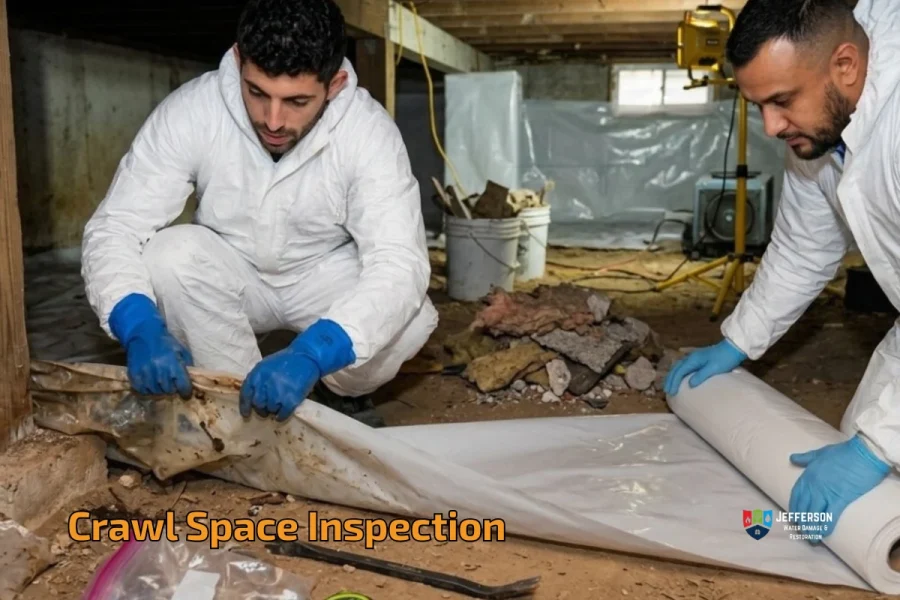
We arrive on-site and conduct a full assessment using thermal imaging cameras and moisture meters. These tools reveal moisture hidden inside walls, floor decking, and framing that is invisible to the naked eye. We identify the water source, map the damage, and document everything before any work begins.
Step 2, Water extraction
Standing water comes out first. We use truck-mounted pumps for high-volume removal and portable extractors for tight access points common in Philadelphia rowhouses. Our water extraction process removes water from soil and surfaces before it migrates further into framing and insulation.
Step 3, Debris and contaminated material removal
Fallen insulation, rotted wood, pest droppings, and other debris exit the space before drying begins. Contaminated materials require careful handling and disposal, particularly when sewage or rodent waste is involved.
Step 4, Structural drying and dehumidification
High-volume air movers and commercial dehumidifiers run continuously until moisture readings in wood framing and subfloor return to acceptable levels. We monitor readings daily and adjust equipment placement as drying progresses.
Step 5, Mold and antimicrobial treatment
We apply EPA-registered antimicrobial agents to all affected surfaces. Where active mold colonies are present, our mold remediation process handles removal and treatment as part of the same job. No waiting for a separate contractor.
Step 6, Odor neutralization
Lingering odors from mold, rodent activity, or sewage contamination require targeted deodorization treatment beyond simple ventilation. We address organic odor sources directly so they do not reappear after the space is sealed.
Step 7, Post-cleanup inspection and documentation.
Final moisture readings, photographs, and a detailed written report provide a clear record of the work performed. This documentation supports insurance claims and gives you a verified baseline for the condition of your crawl space going forward. For full post-cleanup verification, our mold testing service provides air quality clearance testing after remediation is complete.
Step 8, Encapsulation and prevention recommendations.
Once the space is clean and dry, we advise on vapor barrier installation, vent sealing, and humidity control options to prevent recurrence. If a sewage backup contributed to the damage, we coordinate with our sewage cleanup team to confirm the source is fully resolved before any long-term moisture control work begins.
Why Philadelphia Crawl Spaces Are Especially Vulnerable
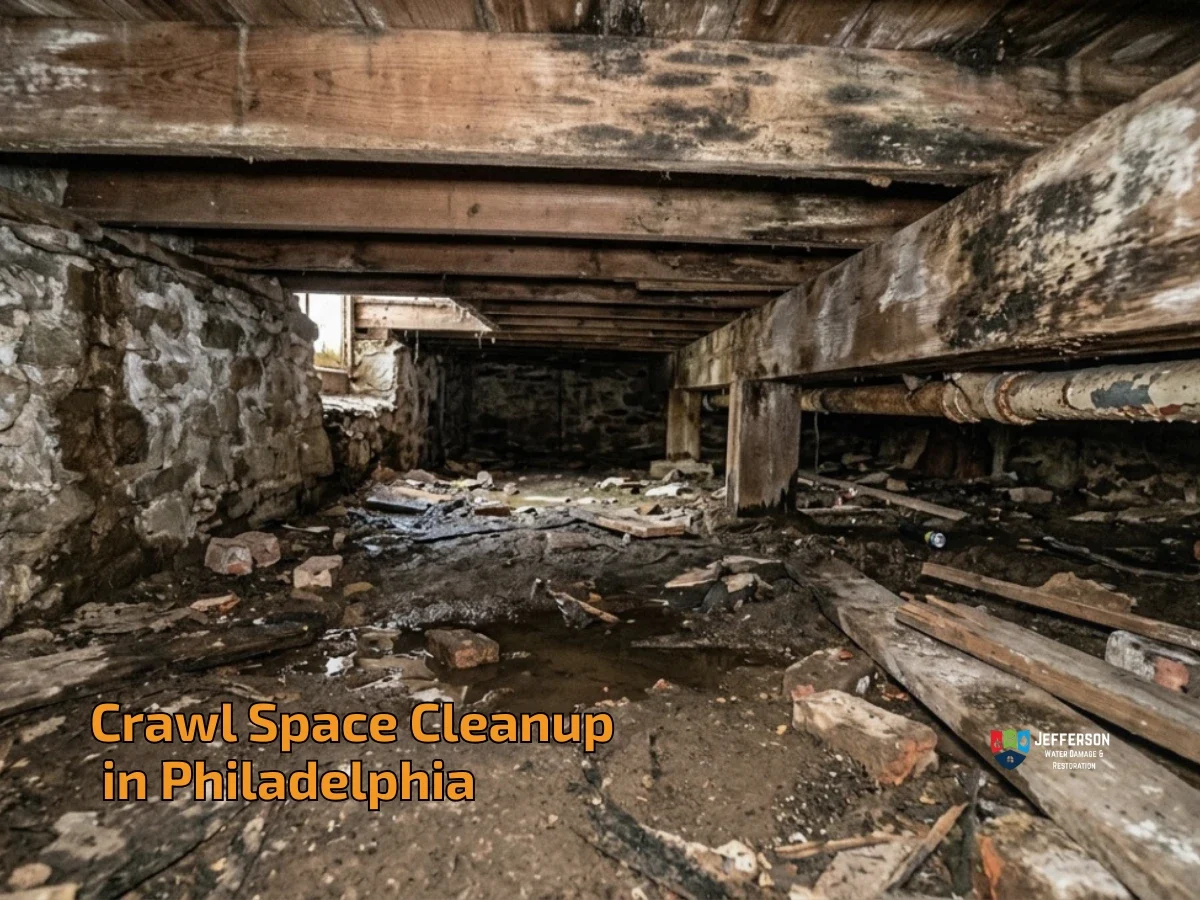
Philadelphia’s housing stock creates crawl space conditions that most national restoration guides never account for. Many homes in Northern Liberties, South Philly, Germantown, and Kensington were built before modern insulation and ventilation standards existed. Their crawl spaces are uninsulated, poorly vented, and in direct contact with soil that shifts with every freeze-thaw cycle. When seasonal moisture fluctuations saturate the ground beneath a rowhouse, that moisture has nowhere to go but up.
Attached rowhouses share foundation walls, which means moisture migrating through one home can affect adjacent properties. Twin homes in the Northeast and pier-and-beam rear additions common in older Philly construction create enclosed spaces that trap humidity year-round. The Delaware River, Schuylkill River, and Wissahickon Creek corridors contribute to elevated groundwater levels in nearby neighborhoods, raising the baseline moisture risk for homes in Fishtown, Manayunk, Roxborough, and East Falls.
Philadelphia’s combined sewer system adds another layer of risk. During heavy rains, stormwater and sewage share the same aging pipes. When that system backs up, crawl spaces on the receiving end face contamination that goes well beyond a simple water problem. Undetected pipe leaks in older plumbing, galvanized steel, cast iron, or original copper, compound the issue further. Many homeowners first notice a problem only when a musty smell has already settled into their living areas, which often means the damage has been building for months.
Pre-1960 Philadelphia housing also raises specific safety concerns. Asbestos-wrapped pipes, knob-and-tube wiring, and lead paint are all documented in crawl spaces of homes built before modern codes. These hazards make professional assessment essential before any cleanup work begins.
Signs You Need Professional Crawl Space Cleanup
Some crawl space problems are obvious. Others build quietly until the damage reaches your living space. These are the most common warning signs Philadelphia homeowners report before calling us.
Persistent musty or damp odor rising through floorboards or present throughout the first floor. This smell typically indicates active mold or mildew growth below the subfloor.
Soft, spongy, or uneven floors that point to moisture-damaged joists or compromised support beams. When wood rot advances far enough, flooring begins to flex underfoot.
Wet or fallen insulation visible through the crawl space access. Saturated insulation loses all thermal value and becomes a direct host for mold growth.
Pooling water or water stains on crawl space walls, floor, or framing. Even staining without active standing water signals past or ongoing intrusion.
Visible mold on joists or subfloor. If you see visible black mold in your crawl space, do not disturb it before professional assessment. Agitated mold spores spread rapidly into living areas.
Pest activity including rodents or termites. Both gravitate toward damp, warm crawl spaces. Rodent droppings and nesting material require professional handling due to health hazards.
Rising energy bills without explanation, often caused by moisture forcing your HVAC system to work harder against humidity that has migrated upward from the crawl space.
Recent flooding, sewage backup, or burst pipes near or beneath the crawl space level. If you have dealt with burst pipes beneath the floor or a basement sewage event, the crawl space is almost always affected.
If mold spreading from crawl space to basement areas is part of what you’re dealing with, our team addresses both spaces as part of the same project rather than treating them as separate scopes.
Crawl Space Cleanup Costs in Philadelphia, What to Expect
Crawl space cleaning in Philadelphia typically costs between $250 and $6,000, with most homeowners paying somewhere in the middle depending on the scope of the job. On a per-square-foot basis, most jobs run between $0.50 and $4.00. Simple debris removal and dry cleanouts fall toward the lower end, while jobs involving standing water, mold treatment, or rodent droppings push toward the higher range.
Water removal from a crawl space typically runs between $1,100 and $4,600, depending on how much water is present, how long it sat, and whether structural materials need drying or replacement. Sewage-involved crawl space cleanup in Philadelphia generally falls between $1,000 and $5,000, depending on the size of the area and the severity of the contamination.
Philadelphia’s older housing stock adds specific cost factors that national pricing guides rarely reflect. Tight crawl space access points common in rowhouses increase labor time. Pre-1960 construction may require hazard assessment before cleanup can begin. Urban project logistics and disposal costs in the Philadelphia market also push final pricing toward the higher end of national ranges.
Many crawl space water damage events are covered by homeowner’s insurance when caused by a sudden event like a burst pipe, appliance failure, or storm. Jefferson assists with claim documentation and works directly with your adjuster.
Call +1 267-641-0090 Jefferson Restoration provides free, on-site inspections so you’ll know the exact cost before any work begins — no surprises, no inflated estimates.
Crawl Space Cleanup vs. Encapsulation, What Philly Homeowners Need to Know
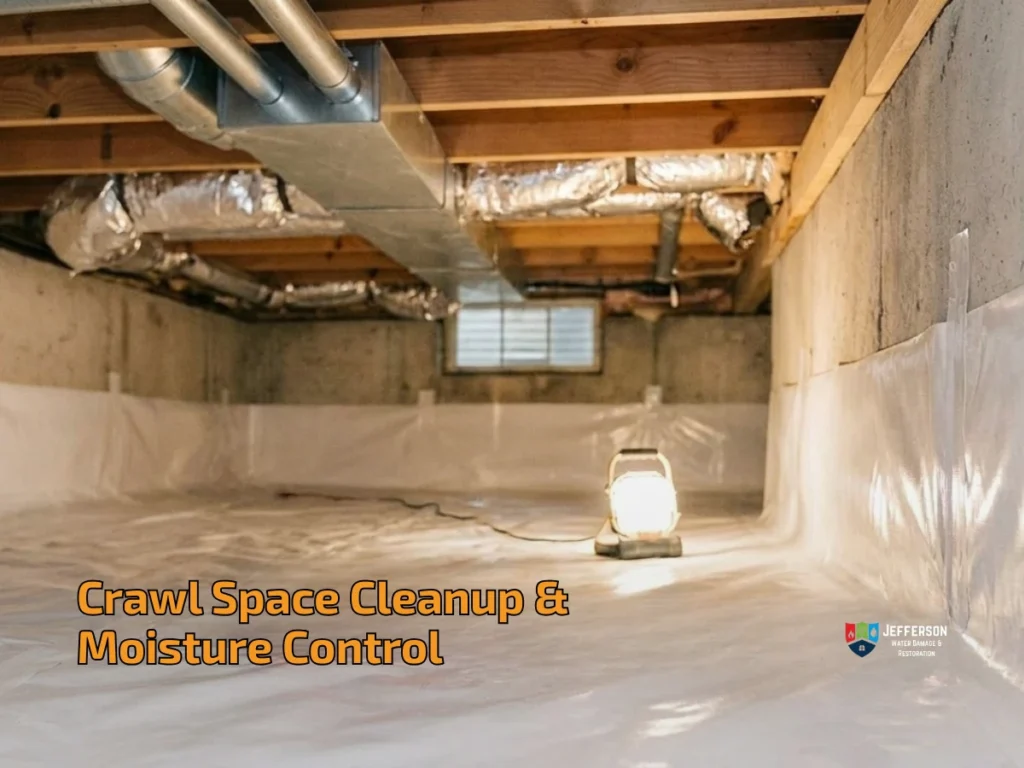
These two services are often confused, and the distinction matters for your budget and your timeline. Cleanup addresses the existing problem: removing water, mold, debris, damaged insulation, odors, and contaminated materials.
Encapsulation prevents future problems by installing a vapor barrier, sealing vents, and introducing controlled dehumidification to the space.
The cleanup phase must always come first. No encapsulation contractor can properly seal a crawl space that still contains mold, wet insulation, or organic debris.
Jefferson handles the restoration scope that makes the space ready for long-term moisture control. Homeowners who properly address their crawl space moisture can see 15 to 20 percent reductions in heating and cooling costs, which makes the full investment worth understanding from the start.
If you are comparing quotes from encapsulation specialists alongside our cleanup estimate, that is a reasonable approach.
The two scopes are complementary. Jefferson completes the cleanup and can advise on what the next step should look like based on the actual condition of your space after we finish.
How Jefferson Restoration Works?
01
Immediate Response
24/7 emergency dispatch
02
Free Assessment
Transparent inspection and estimate
03
Insurance Coordination
We work directly with your provider
04
Restoration & Repair
From damage control to complete rebuild
Jefferson Water Damage & Restoration, Philadelphia's Crawl Space Cleanup Team
Jefferson Water Damage & Restoration is based at 443 W Girard Ave Unit 3G, Philadelphia, PA 19123, and we serve homeowners and businesses across all of Philadelphia and surrounding communities.
Our IICRC-certified technicians respond 24 hours a day, including weekends and holidays. Whether you are in a Northern Liberties rowhouse dealing with a flooded crawl space at 2 AM or a Northeast twin home with a mold problem discovered during a home inspection, we dispatch the same day.
Our service area covers every Philadelphia neighborhood: Fishtown, Kensington, Port Richmond, South Philadelphia, Passyunk Square, Bella Vista, Queen Village, Point Breeze, West Philadelphia, University City, Cobbs Creek, Overbrook, Germantown, Mount Airy, Chestnut Hill, Manayunk, Roxborough, Mayfair, Oxford Circle, Bustleton, Rhawnhurst, Torresdale, Frankford, Center City, Rittenhouse Square, Old City, Society Hill, Fairmount, Strawberry Mansion, Logan, Olney, and more.
We also serve surrounding communities including Upper Darby, Cheltenham, Abington, Norristown, Bensalem, Lansdowne, and Bristol.
Because Jefferson handles the full damage chain, from water damage restoration through crawl space cleanup and mold treatment, you work with one company across the entire scope. No coordinating between contractors. No delays waiting for the next crew to schedule. One call, one project, one invoice.
Frequently Asked Questions About Crawl Space Cleanup in Philadelphia
How much does crawl space cleanup cost in Philadelphia?
Most Philadelphia homeowners pay between $250 and $6,000, depending on the scope of the job. Per square foot, expect $0.50 to $4.00 based on what the work involves. Water removal, mold treatment, and sewage contamination push costs higher, while simple dry cleanouts stay on the lower end. Tight access points in rowhouses and twin homes can add labor time. Jefferson provides free on-site estimates so you know the full scope before any work begins.
What does a professional crawl space cleanup actually include?
A full professional cleanup covers water extraction, removal of damaged insulation and debris, structural drying, mold and antimicrobial treatment, odor neutralization, and post-cleanup documentation. Jefferson also provides insurance-ready reports with moisture readings and photographs at the end of every job. This is a fundamentally different scope from junk removal or a basic dehumidifier setup.
Can I clean my own crawl space, or do I need a professional?
For a dry, accessible crawl space with minor clutter, basic DIY work is possible. For anything involving standing water, mold, sewage, rodent droppings, or structural damage, professional cleanup is the right call. Philadelphia’s pre-1960 homes frequently contain asbestos-wrapped pipes or knob-and-tube wiring in crawl space areas, making professional hazard assessment essential before anyone enters and disturbs materials.
How quickly can Jefferson respond to a crawl space emergency in Philadelphia?
We operate 24 hours a day, seven days a week, including holidays. [DATO: Jefferson’s confirmed average on-site response time in Philadelphia]. The longer a wet crawl space sits untreated, the higher the risk of mold growth and structural damage. If you are seeing standing water or smelling something that was not there before, call us now rather than waiting for business hours.
Will my homeowner's insurance cover crawl space cleanup in Philadelphia?
It depends on the cause of the damage. Most standard homeowner’s policies cover sudden, accidental water damage, such as a burst pipe or an appliance failure that sends water into your crawl space. Damage from flooding, long-term seepage, or deferred maintenance is typically excluded. Mold resulting from a covered water event is sometimes included, but coverage varies by policy and insurer.
I need to leave the house during the crawl space clean up?
In most cases, no. Crawl space work happens below the living area, and daily life above can continue normally during a standard cleanup. Technicians will need access to the crawl space entry point, and there may be some noise from drying equipment left on-site, but most homeowners remain in place throughout the process.
Start your
Crawl Space Cleanup Now
Get a Free Professional Inspection
Local experts • Fast response • No hidden fees