Ceiling Water Damage Repair & Restoration in Philadelphia, PA
Emergency water removal and structural drying for homes and businesses across Philadelphia. Call us now at (267) 641-0090 and we will be there.
- 60 min response
- IICRC Certified #70209237
- We Handle Insurance
Request a Free Inspection
Local experts • Fast response • No hidden fees
A brown stain spreading across the ceiling. A bulge that wasn’t there yesterday. Water dripping through a light fixture at midnight. Ceiling water damage in Philadelphia moves fast, and so does the mold that follows it. Jefferson Water Damage & Restoration responds 24 hours a day to homes and businesses across Philadelphia, PA. We locate the source, dry the structure completely, and restore your ceiling from start to finish. One call handles everything.
Philadelphia's 24/7 Ceiling Water Damage Experts
A ceiling leak rarely announces itself at a convenient time. When it happens, the damage spreads into insulation, ceiling joists, and adjacent walls with every hour that passes. Mold can begin growing within 24 to 48 hours of water exposure, which means a problem you discover on a Tuesday morning is already on a tight clock.
Jefferson Water Damage & Restoration Philadelphia is located at 443 W Girard Ave Unit 3G, Philadelphia, PA 19123. We serve every neighborhood in the city, from Fishtown and Northern Liberties to South Philadelphia, Germantown, and the Northeast. Our technicians are available around the clock, every day of the year.
We handle the full scope of ceiling water damage repair: source identification, water removal, structural drying, mold assessment, materials replacement, texture matching, and painting. You do not need to coordinate separate contractors. Our broader water damage restoration process follows the same principle: one company, complete job.
Call us now at (267) 641-0090 for a free inspection and honest assessment.
Warning Signs Your Ceiling Has Water Damage
Some ceiling leaks are obvious. Others hide behind plaster for weeks before showing themselves. Knowing what to look for helps you act before the damage grows.
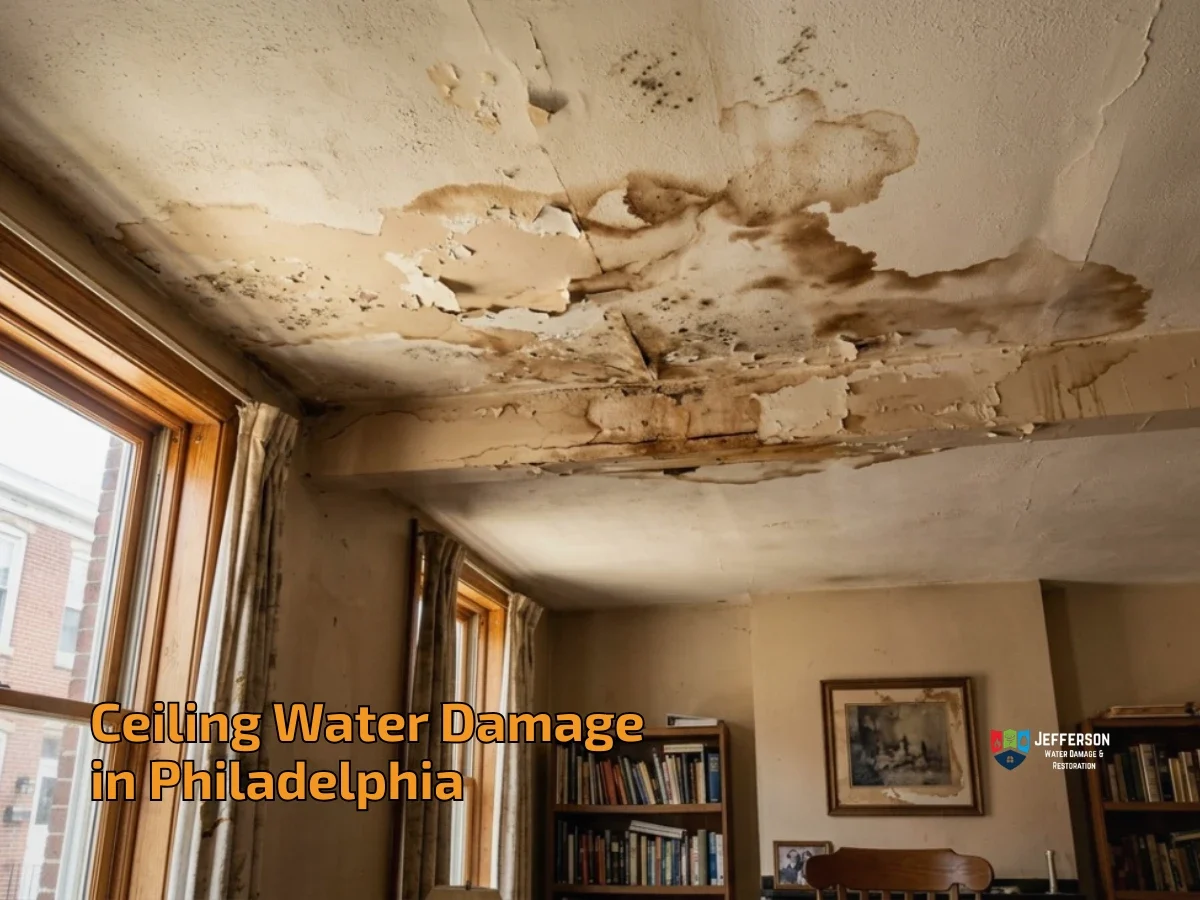
Yellowish-brown stains or discoloration are the most common early signs. Bubbling, sagging, or soft spots in the ceiling surface indicate water has saturated the material. Peeling paint, crumbling plaster, and visible mold patches (dark or fuzzy areas) signal that moisture has been present long enough to cause serious damage.
Actively dripping water, especially near a ceiling fixture or junction box, is an immediate emergency. Water contacting live electrical components creates a real fire and electrocution hazard that competitors rarely mention. Turn off the circuit breaker for that area and call us right away.
Many Philadelphia row homes still have original plaster-and-lath ceilings. Plaster is dense and slow to show surface damage, which means significant structural weakening can happen behind the wall before any visible sign appears. By the time the ceiling sags, the damage is already deep. If you live in a multi-unit building, a condo, or a rowhome conversion, the leak may be coming from a unit above yours. We see this constantly across Fairmount, Society Hill, Old City, and Passyunk Square.
If you are not sure where the water is coming from, our leak detection team uses thermal imaging to pinpoint the source before any repair work begins.
Common Causes of Ceiling Water Damage in Philadelphia Homes
Identifying the source is the first and most important step. Restoring the ceiling before fixing the cause guarantees you will have the same problem again within months.
Plumbing leaks from above are the leading cause in Philadelphia’s multi-story row homes and apartment buildings.
Supply line failures, toilet wax ring failures, washing machine hose blowouts, and drain line leaks all send water straight down through the floor into the ceiling below. Philadelphia’s housing stock includes a large share of homes built before 1950, many with aging galvanized steel or cast iron pipes that corrode from the inside over decades.
Roof leaks are especially common in Philadelphia given the city’s prevalence of flat roofs. Membrane failures, clogged interior drains, damaged flashing around chimneys and skylights, and ponding water all drive moisture into the roof deck and ceiling below. Winter ice dams force water under shingles and into attic spaces. Storm-related damage from wind and heavy rain frequently exposes vulnerable roof penetrations.
HVAC condensation leaks are a quieter but common cause. A disconnected condensate drain line or a clogged AC drip pan overflows into the ceiling cavity, often going unnoticed until significant water accumulation occurs. Upstairs bathroom overflows, including tub overflows, toilet floods, and cracked shower pan liners, create immediate ceiling damage in the room directly below.
Burst and frozen pipes are a seasonal reality in Philadelphia, where January temperatures regularly drop below freezing. Pipes running through exterior walls or unheated spaces are especially vulnerable. Whatever the cause, we locate it and address it before touching the ceiling.
The Ceiling Water Damage Restoration Process
Our process follows IICRC standards at every step. We do not cut corners on drying time or skip the moisture verification step, which is where most problems get missed.
Step 1
Emergency response and inspection. We dispatch a technician to your Philadelphia property and assess the full scope of damage. We identify the water category (Category 1 clean water, Category 2 gray water, or Category 3 black water such as sewage), map moisture migration using thermal imaging cameras and moisture meters, and document everything for your insurance claim.
Step 2
Source identification and containment. We locate and stop the active leak before any restoration work begins. This may involve coordinating with a plumber, addressing a roof penetration, or isolating a failing HVAC component. Restoration without source control is a waste of time and money.
Step 3
Water removal and structural drying. Professional water extraction removes standing water and saturated materials. We then place industrial air movers and commercial dehumidifiers to dry the ceiling cavity, joists, insulation, and adjacent wall surfaces. We monitor moisture readings daily and adjust equipment until every structural assembly returns to acceptable dry standard levels, not just until the surface feels dry to the touch.
Step 4
Mold assessment and remediation. Every ceiling water damage job includes a mold assessment. If mold is present, we handle it in-house. Our mold remediation service follows IICRC S520 protocols. There is no waiting for a separate contractor, no gap between drying and mold removal.
For confirmed black mold, our black mold remediation team manages full containment and removal.
Step 5
Damaged material removal. Saturated drywall, plaster, and insulation come out based on moisture readings, not visual inspection alone. Material that looks intact can still hold enough moisture to feed mold growth. We remove what the meters tell us to remove.
Step 6
Structural repair and reconstruction. If ceiling joists or framing sustained damage, we repair the structural components before closing the ceiling. New drywall or plaster goes in, followed by insulation replacement where needed.
Step 7
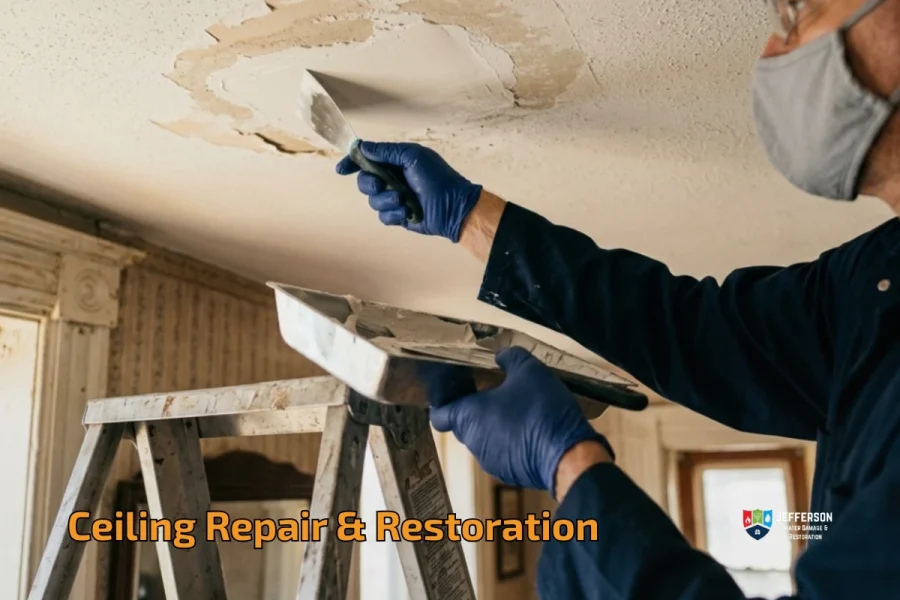
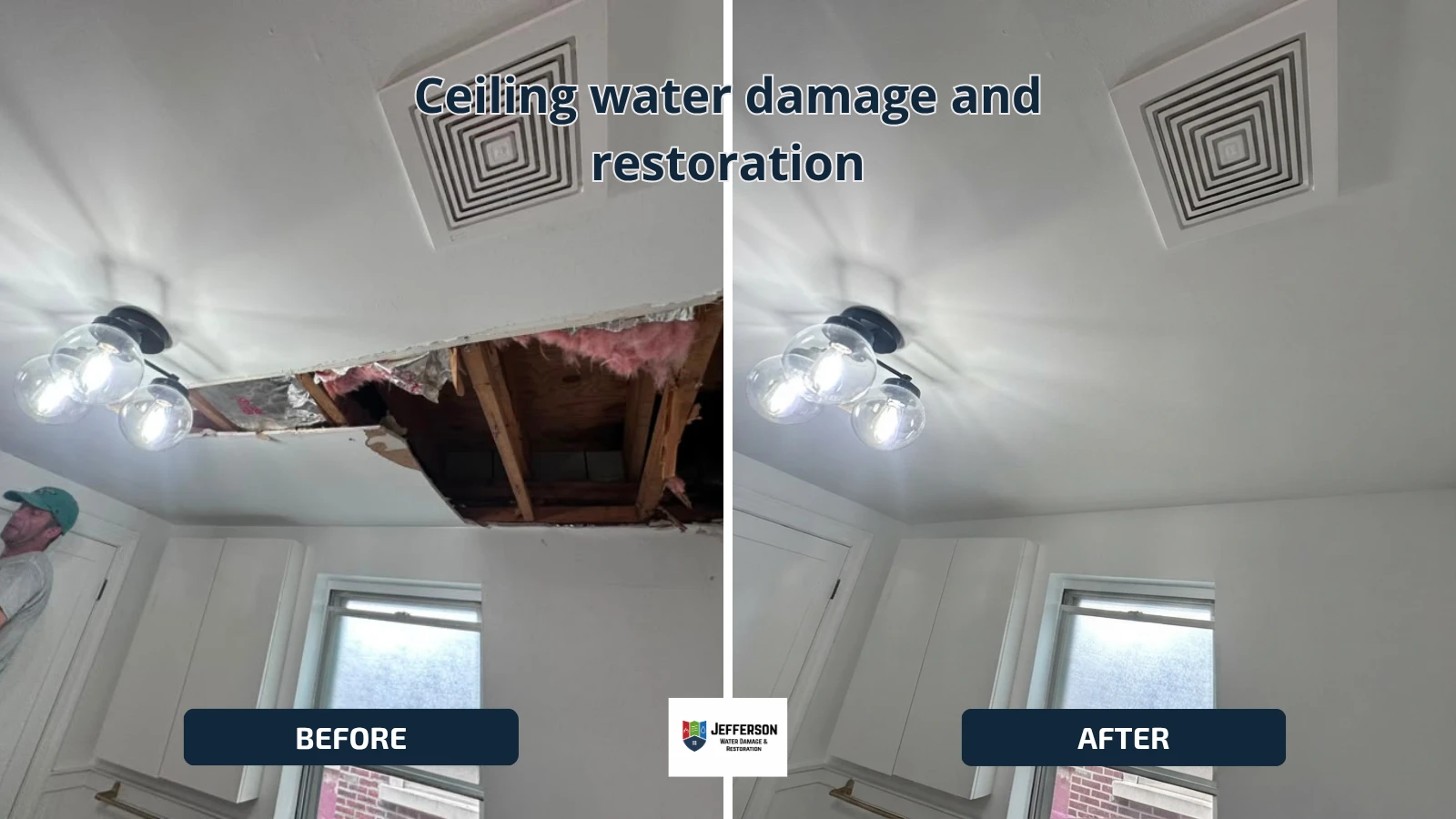
Finishing and texture matching. We tape, mud, sand, prime, and paint. For Philadelphia homes with original smooth plaster, popcorn, skip trowel, or other textured ceilings, we match the existing finish as closely as possible. The goal is a ceiling that looks like nothing happened.
Step 8
Final moisture verification. Before we consider the job complete, we re-test every affected area with moisture meters. A dry reading on every measurement point is the sign-off standard. You receive documentation of those final readings.
What Does Ceiling Water Damage Repair Cost in Philadelphia?
Costs depend on several factors, including the extent of the damage, the type of ceiling material, the square footage affected, the need for mold remediation, and whether structural components need replacement. Plumbing or roofing repairs that caused the leak are billed separately.
Most Philadelphia ceiling water damage repairs fall between $500 and $2,500, with small surface stains and patch jobs on the lower end and full sections requiring drywall replacement, structural drying, or mold treatment on the higher end. Labor and materials for ceiling work typically run $45 to $90 per square foot, depending on the material.
Standard drywall ceilings are the most affordable to repair. Plaster-and-lath ceilings, common in older Philadelphia row homes in neighborhoods like Fishtown, Northern Liberties, and South Philly, cost more because of the additional labor and material complexity. Popcorn ceiling repairs also run higher due to texture matching and the careful handling older popcorn finishes require.
The most important cost factor is timing. Addressing a surface stain right away keeps the repair on the lower end of the range. Waiting allows moisture to spread into the framing and insulation above the ceiling, which expands the scope of the work needed. Overall water damage restoration in Philadelphia averages around $3,800, ranging from $1,300 to $6,300 depending on severity. Acting fast is the most reliable way to stay at the lower end of that range.
Jefferson provides free in-home inspections and itemized estimates, so you’ll know exactly what the repair will cost before any work starts — no surprises, no inflated quotes.
Why Philadelphia Homeowners Choose Jefferson Water Damage & Restoration
Philadelphia is not a city of generic houses. It is a city of row homes, trinity houses, multi-unit conversions, 100-year-old plaster ceilings, and shared walls between neighbors. National franchise templates do not address any of that. Jefferson does, because we have been working in these homes since 1993.
We respond 24 hours a day, 7 days a week. When you call, you reach our dispatch team directly. No answering service, no next-business-day callback. Our team handles source control, extraction, drying, mold assessment, and full ceiling reconstruction under one roof. You do not manage three separate contractors. You call once and we handle the rest.
Our IICRC-certified process includes post-drying moisture verification before we close any job. That final step is what prevents the mold call three weeks later. We also handle insurance documentation from the initial moisture mapping through the final sign-off report, giving your adjuster everything they need to process the claim efficiently.
For commercial property owners, we bring the same process to Philadelphia offices, retail spaces, and multi-unit buildings. Our commercial water damage restoration service is available 24/7 with the same rapid response commitment.
Jefferson Water Damage & Restoration Philadelphia is part of the fabric of this city. We work in Brewerytown, Bella Vista, Chestnut Hill, Kensington, Manayunk, Port Richmond, and every neighborhood in between. We are Philadelphia’s local restoration team, and we show up when it matters.
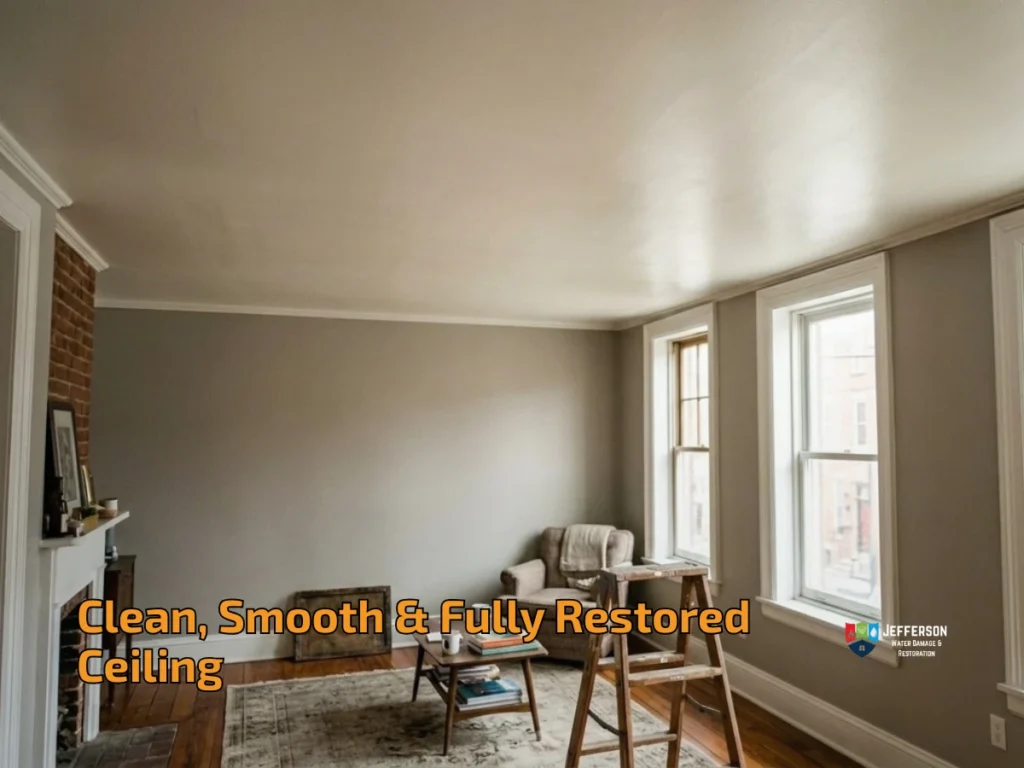
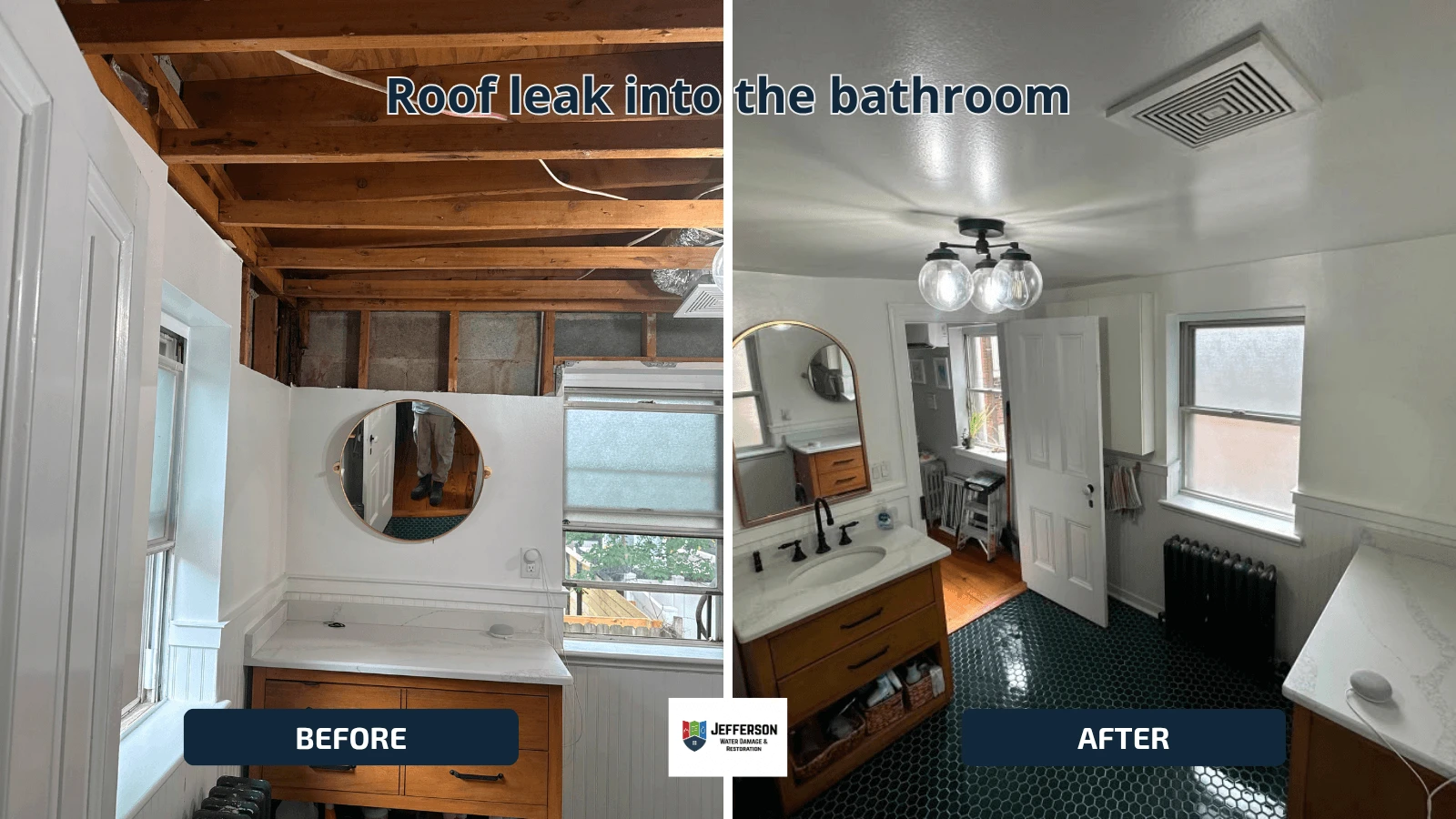
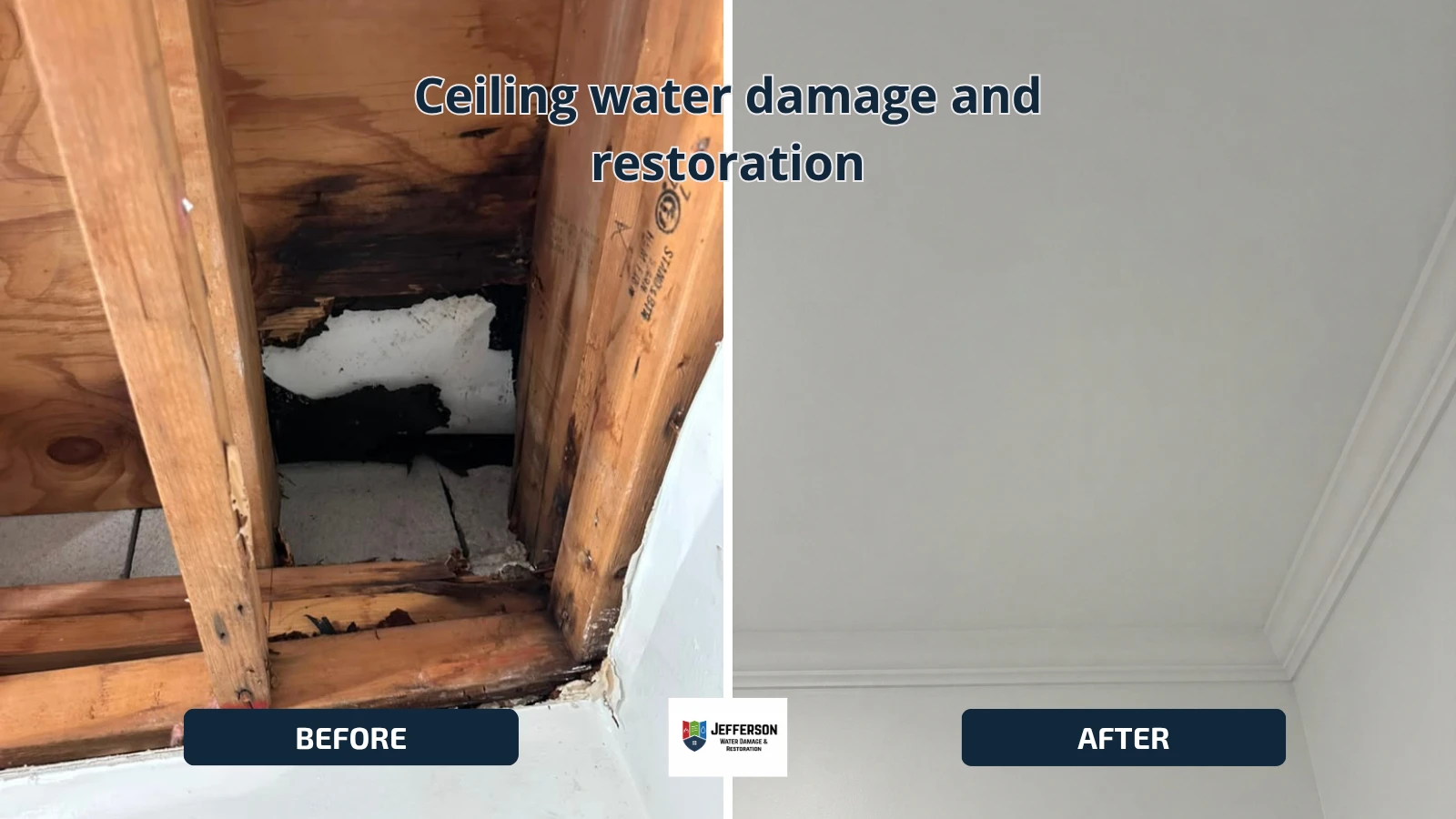
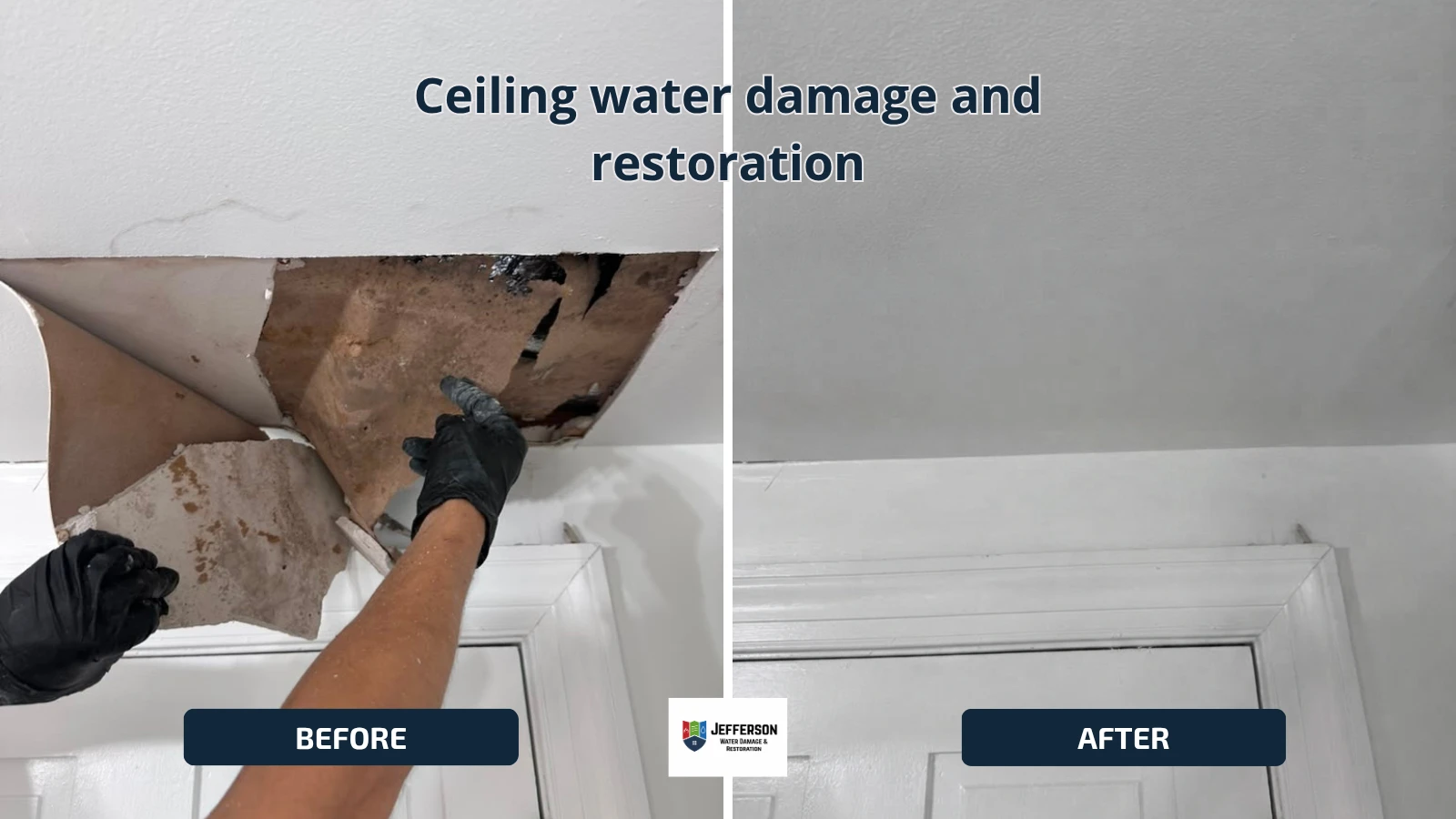
How Jefferson Restoration Works?
01
Immediate Response
24/7 emergency dispatch
02
Free Assessment
Transparent inspection and estimate
03
Insurance Coordination
We work directly with your provider
04
Restoration & Repair
From damage control to complete rebuild
Serving Every Philadelphia Neighborhood
Jefferson Water Damage & Restoration serves ceiling water damage repair calls throughout all of Philadelphia, PA.
Our coverage includes Center City, Rittenhouse Square, Old City, Society Hill, Fishtown, Northern Liberties, Brewerytown, Fairmount, Spring Garden, Bella Vista, Queen Village, Passyunk Square, Graduate Hospital, Point Breeze, South Philadelphia, Germantown, Chestnut Hill, Mt. Airy, Manayunk, Roxborough, East Falls, West Philadelphia, University City, Powelton Village, Cobbs Creek, Overbrook, North Philadelphia, Strawberry Mansion, Hunting Park, Logan, Olney, Oak Lane, Frankford, Mayfair, Rhawnhurst, Oxford Circle, Bustleton, Somerton, Torresdale, Holmesburg, Tacony, Port Richmond, Bridesburg, Grays Ferry, and Southwest Philadelphia.
We cover all Philadelphia ZIP codes including 19102, 19103, 19104, 19106, 19107, 19111, 19114, 19115, 19116, 19118, 19119, 19120, 19121, 19122, 19123, 19124, 19125, 19126, 19127, 19128, 19129, 19130, 19131, 19132, 19134, 19135, 19136, 19137, 19138, 19139, 19140, 19141, 19142, 19143, 19144, 19145, 19146, 19147, 19148, 19149, 19150, 19151, 19152, 19153, and 19154.
Need ceiling water damage repair in Philadelphia, PA? Call (267) 641-0090 for a free inspection and a clear estimate before any work begins.
Frequently Asked Questions About Ceiling Water Damage in Philadelphia
How do I know if my ceiling water damage is an emergency?
Treat it as an emergency if you see any of the following: water that won’t stop dripping, a visibly sagging or bulging area at risk of collapse, water near a light fixture or ceiling fan, a ceiling that has already partially fallen, or water that appears dark or smells foul. Water contacting ceiling electrical components creates a serious fire and electrocution hazard. Call Jefferson at (267) 641-0090 immediately, at any hour.
Will homeowner's insurance cover my ceiling water damage?
Most policies cover sudden and accidental damage from causes like a burst pipe or appliance failure. Gradual leak damage and roof leak damage may face coverage limitations depending on your specific policy. Document everything with photos and video before cleanup begins, and avoid permanent repairs until your adjuster has assessed the damage. Jefferson assists with documentation and communicates directly with your insurance carrier throughout the process.
How quickly does mold grow after a ceiling leak?
Mold can begin developing within 24 to 48 hours of water exposure. Philadelphia’s humid summers accelerate this timeline further. Surface drying is not sufficient. Hidden moisture inside the ceiling cavity, insulation, and joists continues feeding mold growth long after the surface appears dry. Jefferson uses moisture meters to verify the complete structural assembly is dry before closing any job. If mold is present, our mold remediation and mold inspection services address it directly.
Can I just paint over the water stain?
Painting over a stain without resolving the source and confirming the ceiling is dry hides an ongoing problem. If moisture remains inside the ceiling cavity, the stain returns quickly and mold continues to develop behind the surface. If the leak source has been professionally resolved and a moisture meter confirms the assembly is dry, a stain-blocking primer followed by paint is appropriate for minor surface staining. Jefferson always addresses the source and verifies dryness before any cosmetic work.
My ceiling damage is in a Philadelphia condo. Whose responsibility is it?
If water originates from a unit above, your neighbor’s insurance or the building’s master policy may be responsible, depending on your condo association’s governing documents. If the leak comes from a common-area pipe or the building’s roof, the association’s master policy typically applies. Document everything in writing, notify building management, and call Jefferson right away to stop further damage. We work with all insurance providers and can help navigate claims regardless of which policy applies.
How long does ceiling water damage restoration take?
Small areas can often be completed in one to two days. A full restoration for a larger ceiling in a Philadelphia row home typically follows this timeline: emergency response and source control on the same day, structural drying over three to five days using commercial equipment, followed by materials replacement and finishing work over one to three additional days depending on scope. Plaster ceiling repairs take longer due to multi-coat application. Jefferson provides a timeline estimate during the initial assessment so you know what to expect before work begins.
Stop
Ceiling Damage Now
Get a Free Professional Inspection
Local experts • Fast response • No hidden fees