Attic Mold Remediation in Philadelphia, PA
Row Homes, Twin Homes & Beyond
24/7 Response by Certified Technicians across Philadelphia. Call us now at (267) 641-0090 and we will be there.
- 60 min response
- IICRC Certified #70209237
- We Handle Insurance
Request a Free Inspection
Local experts • Fast response • No hidden fees
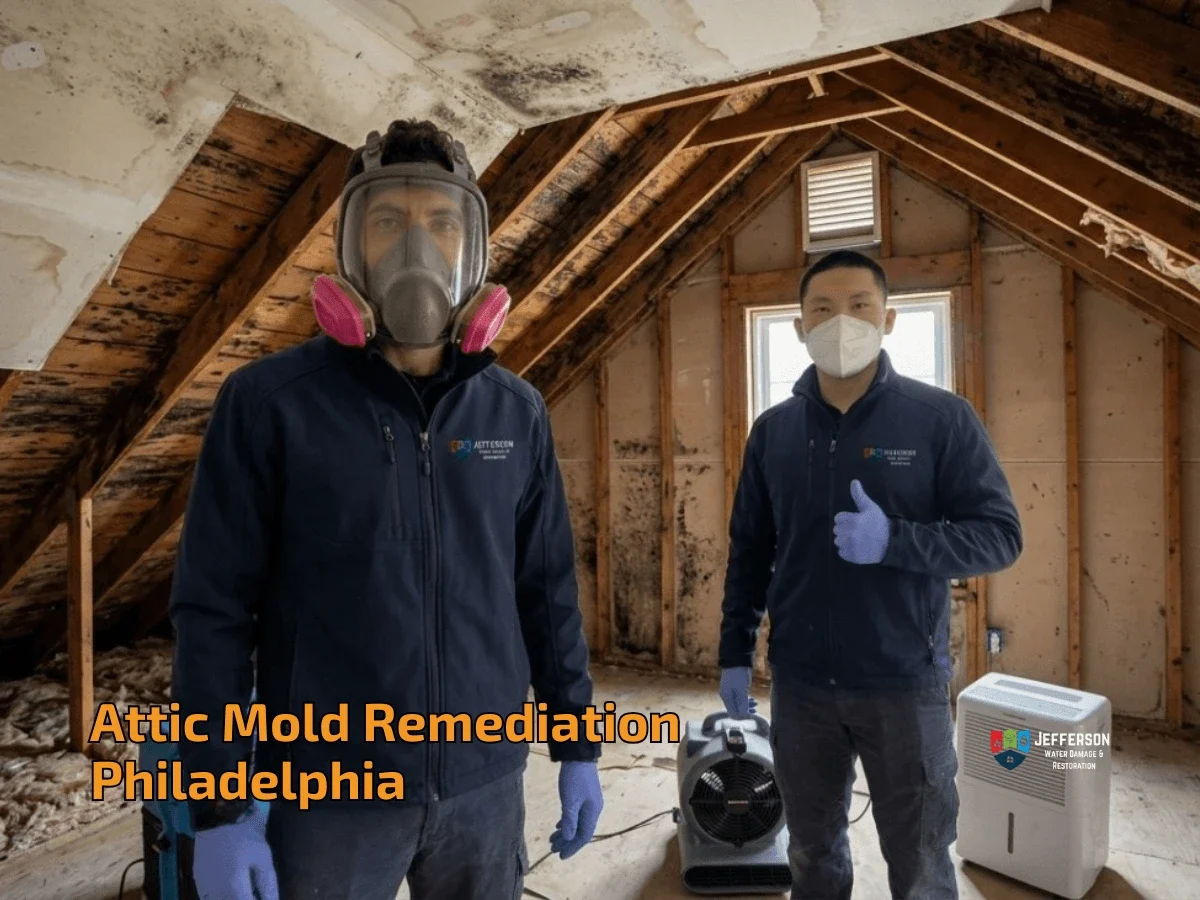
Attic mold is one of the most common and most overlooked problems in Philadelphia homes. Because most homeowners never go into their attic, mold can colonize roof sheathing, rafters, and insulation for months before anyone notices. By then, what might have been a modest remediation job has grown into a structural repair.
Jefferson Water Damage & Restoration Philadelphia responds 24/7, inspects your attic thoroughly, and treats both the mold and the moisture source that caused it. Call us now at (267) 641-0090 for a free, no-obligation inspection.
Why Philadelphia Attics Are a Mold Hot Spot
Philadelphia sits in ASHRAE Climate Zone 4A, a Mixed-Humid designation that means high summer humidity and cold winters work against each other inside attic spaces. The city’s annual average outdoor relative humidity of 68% consistently exceeds the 60% threshold at which mold growth accelerates. In older homes, that humidity has nowhere to go.
More than half of Philadelphia’s residential buildings predate 1950. Row homes in Fishtown, Kensington, and South Philadelphia. Twin homes across Northeast Philadelphia. Victorian detached houses in Mt. Airy and Germantown. Pre-war flat-roof row homes throughout Point Breeze and Grays Ferry. These structures were built without modern vapor barriers, ridge ventilation standards, or the exhaust routing requirements that current building codes require.
The single most underdiagnosed cause of attic mold in Philadelphia is misrouted exhaust fans. Bathroom, kitchen, and dryer vents in row homes are frequently terminated under the roof deck rather than to the exterior. Every shower, every dryer cycle, and every meal sends warm, humid air directly into the attic cavity.
When that air contacts cold roof sheathing in winter, it condenses. That repeated condensation cycle creates exactly the sustained moisture that mold needs. Nearly 90% of attic mold cases trace back to ventilation problems, and misrouted fans are a leading driver in Philadelphia’s housing stock specifically.
Seasonal freeze-thaw cycles compound the problem. Ice dams at the roofline force water under shingles and into attic framing. Rear flat-roof additions on South and West Philadelphia row homes pond water and allow moisture intrusion into ceiling joists. In leafy neighborhoods like Fairmount, Chestnut Hill, and Manayunk, clogged gutters accelerate moisture entry at the roofline. If you have noticed ceiling water damage from roof leaks, the source may already be affecting your attic.
Signs You Have Attic Mold in Your Philadelphia Home
Attic mold rarely announces itself directly. Most homeowners discover it during a roof repair, an energy audit, or a home sale inspection. Knowing what to watch for on the floors below the attic can prompt you to act before the problem grows.
- Musty odor on upper floors or near the attic access hatch: This is frequently the first signal. The smell intensifies in warm weather when mold colonies become more active.
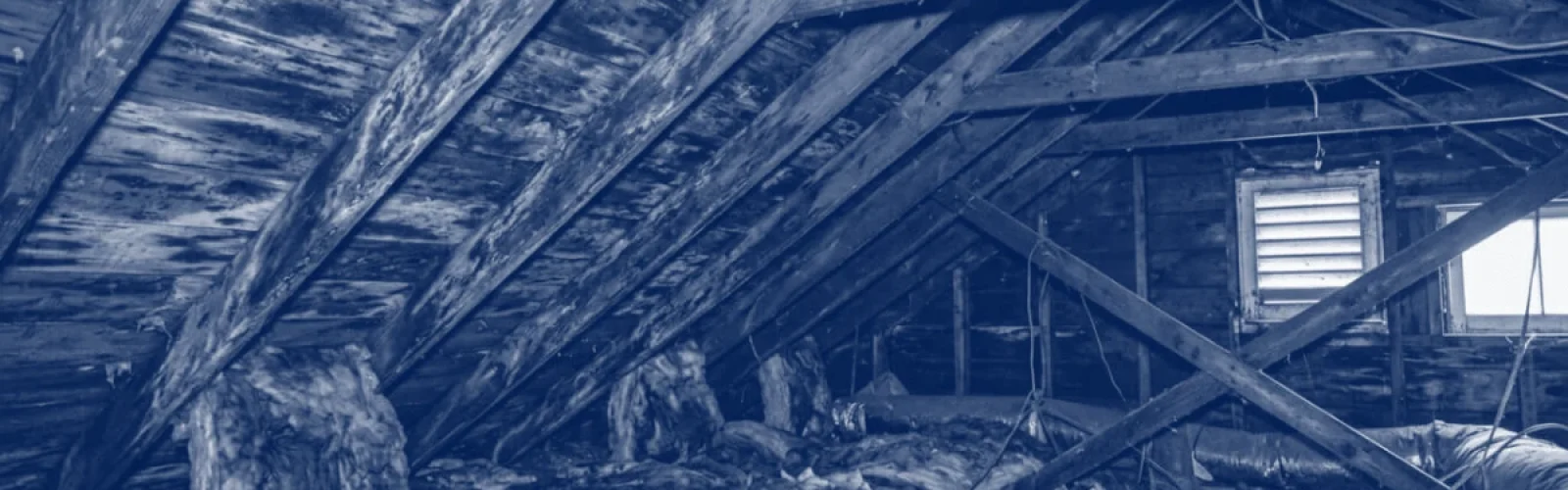
- Dark staining on rafters or roof decking: Black, green, or gray discoloration on wood surfaces is a direct sign of active mold colonization.
- Damp, compressed, or discolored insulation: Fiberglass or cellulose insulation that has absorbed moisture loses its R-value and becomes a growth medium for mold.
- Unexplained allergy symptoms that improve when you leave home: Persistent coughing, congestion, or eye irritation can signal airborne spores migrating down from the attic through recessed lights and attic bypasses.
- Water stains on upper-floor ceilings: Moisture migrating downward from the attic leaves staining on drywall, even without a visible drip. Schedule a professional mold inspection if you notice staining you cannot explain.
- Ice dams in winter and high cooling costs in summer: Both indicate compromised attic insulation and ventilation, which are the same conditions that set the stage for mold growth.
Our Attic Mold Remediation Process
Jefferson follows IICRC S520 protocols for mold remediation on every attic job. That means a defined, documented process from the first inspection through post-clearance testing. Here is what that looks like in your home.
Step 1: Inspection and Moisture Mapping
We use thermal imaging cameras and moisture meters to locate the origin of the contamination, not just the visible mold. We identify whether the source is an active roof leak, a misrouted exhaust fan, blocked soffit vents, or condensation from inadequate ridge ventilation. Treating mold without finding the source guarantees recurrence. If professional leak detection points to a broader moisture issue, we address it as part of the same project.
Step 2: Containment
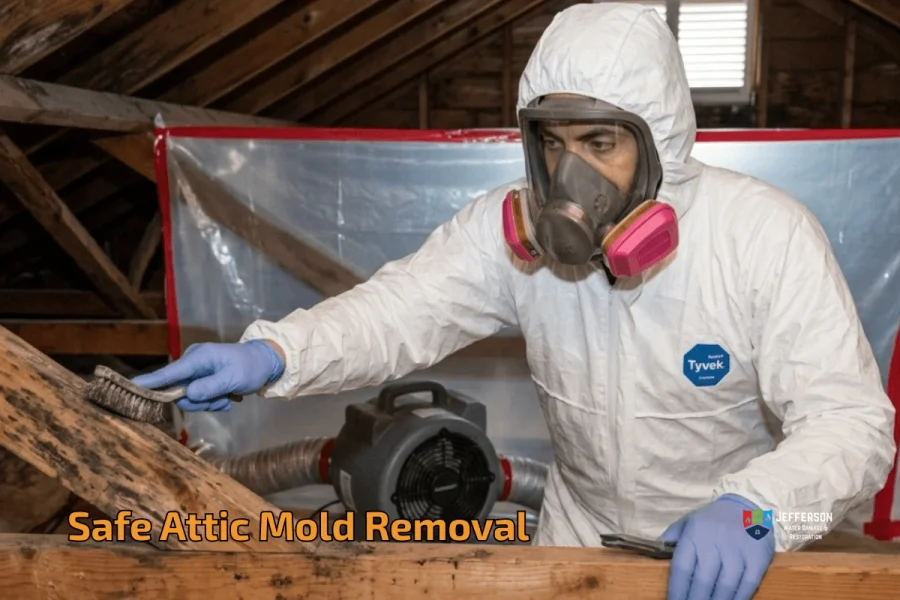
Before any mold is disturbed, we seal the work zone with plastic barriers and establish negative air pressure using HEPA-filtered air filtration devices. This prevents spores from migrating into living areas below, which is especially important in Philadelphia row homes where the attic sits directly above occupied bedrooms.
Step 3: Mold Removal
Mold-colonized materials come out first. Contaminated insulation is bagged and removed to EPA disposal standards. Affected sheathing and rafter surfaces receive HEPA vacuuming followed by wet-washing with EPA-registered antimicrobial solutions. Where mold has penetrated wood fibers, we sand and encapsulate rather than surface-wipe, which is the only method that actually eliminates the colony.
Step 4: Structural Drying
Industrial dehumidifiers and air movers eliminate residual moisture from attic framing. This step matters more in Philadelphia than in drier climates. With outdoor humidity averaging 68%, attic wood that is not brought down to safe moisture content will simply re-colonize. We monitor readings daily until every surface reaches acceptable levels.
Step 5: Ventilation Correction
This is where Jefferson’s approach differs from companies that only treat the mold. We correct misrouted exhaust fans so they vent to the exterior, clear blocked soffit vents, and recommend ridge ventilation upgrades where needed. Fixing the moisture source is not a separate contractor’s job. It is part of our scope. This step is the reason attic mold does not come back after we leave.
Step 6: Post-Remediation Clearance Testing
After work is complete, we conduct air quality testing to confirm mold spore counts have returned to safe levels before reopening the work zone. This is not an optional add-on. It is how we confirm the job is done. Lab results typically come back within 24 to 48 hours.
Step 7: Insulation Replacement and Restoration
Where insulation was removed, we replaced it with mold-resistant materials sized to Philadelphia’s climate zone requirements. Affected joists or sheathing that required sanding are sealed and encapsulated. When restoration is complete, your attic is structurally sound, properly ventilated, and protected against recurrence. For any related water damage restoration that extends beyond the attic, our team handles it as part of the same project.
How Much Does Attic Mold Remediation Cost in Philadelphia?
Attic mold remediation in Philadelphia typically ranges from $1,500 to $5,000 for most residential projects. On a per-square-foot basis, expect $4 to $8 depending on the scope, accessibility, and severity of the contamination.
Several factors determine where your project lands in that range. Attic accessibility matters: a finished attic with a standard door is far easier to work in than a low-slope crawl attic accessed through a 24-inch hatch. The extent of insulation removal and replacement adds cost, as does the presence of black mold (Stachybotrys), which requires full containment protocols not needed for surface molds like Cladosporium or Aspergillus.
If the roof decking requires sanding and encapsulation across large surface areas, that increases both labor time and material cost. Catching attic mold early keeps the project on the lower end of the range. When moisture is addressed before it reaches roof decking and trusses, the repair stays focused on remediation rather than expanding into structural work.
Mold testing is free for most visual inspections. If lab sampling is required to confirm the type of mold or rule out hidden contamination, testing typically runs up to $300.
If your attic mold resulted from storm damage to your roof, your homeowners insurance policy may cover part or all of the remediation cost. Mold from long-term ventilation neglect is typically excluded from standard coverage. Jefferson documents all damage thoroughly and coordinates directly with your adjuster to support the claims process.
Call (267) 641-0090 for a free attic mold estimate — we inspect the attic, identify the moisture source, and give you a clear scope before any work begins. No surprises, no inflated quotes.
Professional Remediation vs. DIY
The EPA sets a 10-square-foot limit for safe DIY mold cleanup. Attic mold in Philadelphia homes almost always exceeds that threshold before it is ever discovered. Attempting to clean mold in an attic without negative air pressure containment releases spores throughout the home, turning a contained attic problem into whole-house contamination.
Surface wiping with bleach does not eliminate mold that has penetrated wood fibers. Without sanding and encapsulation, the colony remains active inside the material and regrows within weeks. DIY treatment that does not correct the ventilation failure or exhaust fan routing that caused the mold guarantees recurrence.
IICRC-certified remediation also includes post-clearance testing that no DIY approach can replicate, which is the only way to confirm the attic is actually safe.
Preventing Attic Mold in Your Philadelphia Home
After remediation is complete, the goal is to keep moisture out of the attic permanently. For Philadelphia’s housing stock, that means a few specific actions.
- Confirm that all bathroom, kitchen, and dryer exhaust fans vent directly to the exterior, not under the roof deck. This is the single highest-impact prevention step for row homes and twin homes throughout the city.
- Keep indoor humidity below 50%. Philadelphia’s outdoor average of 68% means passive humidity control is rarely enough. A dehumidifier in upper living areas helps reduce the moisture load reaching the attic.
- Clear gutters seasonally, especially in tree-lined neighborhoods like Fairmount, Chestnut Hill, Manayunk, and Mt. Airy, where debris accumulates fastest.
- Inspect your attic after major storm events. High winds and ice dams are common causes of roof intrusion across the city, from Northeast Philadelphia rowhouses to West Philadelphia Victorians.
- Install a humidity sensor at the attic access point. A reading above 70% inside the attic warrants investigation before mold has a chance to establish.
- Schedule an annual attic inspection, particularly for pre-1950 row homes and twin homes in North, South, and West Philadelphia. Annual mold inspections catch moisture problems before they become remediation projects.
About Jefferson Water Damage & Restoration Philadelphia
Jefferson Water Damage & Restoration Philadelphia operates 24 hours a day, seven days a week, with an average response time of one hour. Our IICRC-certified technicians work in Philadelphia homes every day, from row homes along Frankford Avenue and Passyunk Avenue to twin colonials in the Northeast, from brownstones in West Philadelphia to Victorian detached homes in Germantown and Chestnut Hill.
We are based at 443 W Girard Ave Unit 3G in Philadelphia, PA 19123, and we serve every neighborhood in the city as well as surrounding communities in Montgomery, Delaware, and Bucks Counties.
We handle attic mold remediation from inspection through final restoration, including ventilation correction, insulation replacement, and insurance documentation, all under one roof. No coordinating multiple contractors. No gaps in accountability. For any mold problem that extends beyond the attic, our full-service mold remediation team is ready. Call (267) 641-0090 now or request a free attic inspection online.
Serving Philadelphia Neighborhoods, Jefferson Responds Fast
We serve Northern Liberties (19123), Fishtown (19125), Kensington (19134), Port Richmond (19134), Brewerytown (19121), Fairmount (19130), Spring Garden (19130), Callowhill (19123), Strawberry Mansion (19121), Frankford (19124), Bridesburg (19137), Tacony (19135), Holmesburg (19136), Mayfair (19135), Bustleton (19115), Fox Chase (19111), Rhawnhurst (19111), and all of Northeast Philadelphia (19114, 19116, 19152, 19154).
We also respond throughout Olney (19120), Germantown (19144), Mt. Airy (19119), Chestnut Hill (19118), Roxborough (19128), Manayunk (19127), East Falls (19129), Hunting Park (19140).
West Philadelphia (19104, 19139, 19143), University City (19104), Grays Ferry (19146), Point Breeze (19146), Passyunk Square (19148)
South Philadelphia (19147, 19148, 19145), Rittenhouse Square (19103)
Center City (19102, 19103, 19107), Old City (19106), and Society Hill (19106).
Outside the city, we serve Cheltenham, Elkins Park, Jenkintown, Abington, Norristown, Conshohocken, King of Prussia, Upper Darby, Drexel Hill, Springfield, Media, and Chester.
Frequently Asked Questions About Attic Mold Remediation in Philadelphia
What causes attic mold in Philadelphia homes?
The most common causes are inadequate ventilation, misrouted exhaust fans, and roof leaks. In Philadelphia row homes and twin homes, bathroom, kitchen, and dryer vents are frequently routed under the roof deck rather than to the exterior. Warm humid air from those vents meets cold attic surfaces in winter and condenses, creating sustained moisture.
Philadelphia’s annual average outdoor humidity of 68% compounds this, as does the city’s aging pre-1950 housing stock built without vapor barriers or modern ridge ventilation standards.
How much does attic mold remediation cost in Philadelphia?
Most residential projects in Philadelphia range from $1,500 to $8,000, with the Northeast region commanding approximately $4.25 to $8.50 per square foot.
Key cost drivers include attic accessibility, the extent of insulation removal and replacement, whether structural sheathing requires sanding and encapsulation, and whether Stachybotrys is present. Pre- and post-clearance air quality testing typically adds $250 to $600.
Jefferson provides free on-site attic inspections with no obligation before any work begins.
Is attic mold dangerous to my family's health?
Yes. Attic mold releases spores that migrate into living spaces through attic bypasses, recessed lighting, and HVAC returns. Exposure causes nasal congestion, throat irritation, coughing, wheezing, and eye irritation. People with asthma or weakened immune systems experience more severe effects.
Nationally, an estimated 4.6 million asthma cases are attributed to mold exposure at home. Health symptoms that worsen at home and improve when you leave are an important early warning sign worth taking seriously.
Can I stay in my house during attic mold remediation?
For small, well-contained projects, it may be possible to remain on lower floors.
For larger Philadelphia attic jobs involving significant mold coverage on roof sheathing, rafters, and insulation, temporary relocation is often recommended during active remediation. Jefferson sets up containment barriers and HEPA air filtration before any mold is disturbed and will advise you specifically based on the scope of your job during the free inspection.
How long does attic mold remediation take?
Most projects take one to three days. A modest infestation confined to a small section of sheathing may be completed in a single day. Larger projects involving full insulation removal, extensive roof deck treatment, and ventilation correction typically take two to four days.
Post-remediation clearance testing adds 24 to 48 hours for lab results. Jefferson provides a specific timeline during the free inspection based on your attic’s actual conditions.
Will my homeowners insurance cover attic mold remediation?
It depends on the cause. Attic mold resulting from a sudden and accidental covered event, such as storm damage or a burst pipe, may be covered. Mold from long-term ventilation neglect is typically excluded.
Jefferson documents all damage thoroughly and assists with the insurance claims process. Contact us before beginning any work if you believe the damage may be insurance-related.
How is attic mold different from basement mold?
Attic mold primarily affects wood structural materials such as roof decking, rafters, and insulation, and is most often caused by ventilation failures or roof leaks. Basement mold more commonly affects drywall, concrete block, and stored contents, driven by groundwater intrusion or plumbing leaks.
Attic mold also tends to cover larger surface areas before discovery because most homeowners rarely inspect their attic. For basement mold concerns, see our basement mold remediation page.
Stop
Mold Growth in Your Attic
Get a Free Professional Inspection
Local experts • Fast response • No hidden fees